
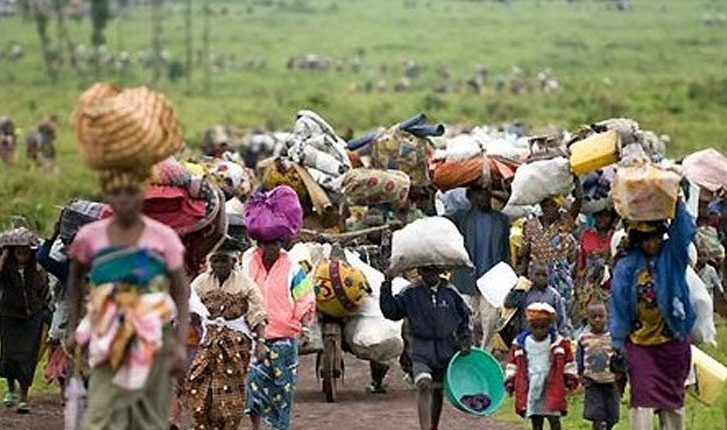
As dusk falls over Niamey’s largest public cemetery, the silence of the graves is broken not by prayers, but by the muffled cries of hungry children and the rustle of families settling down for another night among tombstones. In one of the most haunting images yet of the Sahel’s deepening humanitarian crisis, hundreds of Nigerians fleeing violence, poverty and displacement are now living in a graveyard—because it is the only place left that will have them.
The refugees, mainly from Katsina, Zamfara and Borno states, crossed into Niger Republic to escape banditry, Boko Haram insurgency and collapsing livelihoods back home. What they found, however, was not safety, but rejection.
According to multiple accounts gathered by PRNigeria and international media, the families were pushed into the cemetery after being evicted from informal settlements by security operatives and turned away by surrounding communities. With no official refugee camp, no permanent shelter and little access to aid, the dead have become their closest neighbours.
“We are unwanted people,” said Shamsuddeen Maman, one of the displaced men, his voice heavy with exhaustion. “Whenever we try to enter towns, we are chased away. The graveyard belongs to no one, so we stay here. Sometimes a stranger pities us—that is how we survive.”
A report by Deutsche Welle (DW) revealed that the cemetery became a last refuge after repeated expulsions from urban areas. Security raids dismantled makeshift camps, forcing families to move again and again—until there was nowhere left to go.
Fatima Sani, who fled Katsina after relentless bandit attacks, said police officers drove them out of their previous shelter.
“They threw us out,” she said. “Now our children sleep outside in the cold. We need urgent help.”
For women and children, the conditions are especially brutal. Many sleep in the open, exposed to harsh weather, hunger and disease. There is little food, no sanitation, and no sense of safety—only the psychological weight of living among graves.
For some, the trauma did not end with displacement. Na’ima Abubakar recalled a violent attack on their former camp, where shelters were torched and humanitarian supplies destroyed.
“They set the place on fire. We were beaten and chased away,” she said. “Some children were burned. Food given to us by the Red Cross was reduced to ashes.”
Her appeal is simple and desperate: intervention from the Nigerian government.
“We are begging the Nigerian Ambassador to Niger to help us. If we can return home safely, that would be the best solution.”
Beyond the immediate suffering, the crisis is quietly stealing the future of an entire generation. Children who should be in classrooms now wander between gravestones.
Yusuf Ibrahim, a displaced youth, summed up the heartbreak in a few words:
“I wanted to go to school. Now we cannot even eat. I am just hungry.”
Among the refugees are survivors of Nigeria’s decade-long insurgency. Fatima Hassan, from Chibok in Borno State, lost her husband and parents to Boko Haram before fleeing to Niger.
“I ran because death followed us everywhere,” she said. “But here, life is disappearing slowly.”
The crisis has also reopened painful questions about the historic bond between Nigeria and Niger—two countries often described as brothers.
“That brotherhood does not reflect our reality,” said Zaharadden Lawan Yusuf. “We have lost our dignity.”
Some local residents have accused the refugees of petty crime, allegations the displaced strongly reject.
“It is not true that we steal,” said Abubakar Ali. “Criminals take advantage of our situation and blame us.”
As the humanitarian emergency worsens, the refugees are calling on the Nigerian Ministry of Foreign Affairs, the Nigerian Embassy in Niger, and international aid agencies to act swiftly—either by facilitating their safe return home or providing urgent life-saving assistance.
Until then, hundreds of Nigerians will continue to sleep among the dead in Niamey—living proof that for many fleeing violence in the Sahel, survival itself has become a grave struggle.