
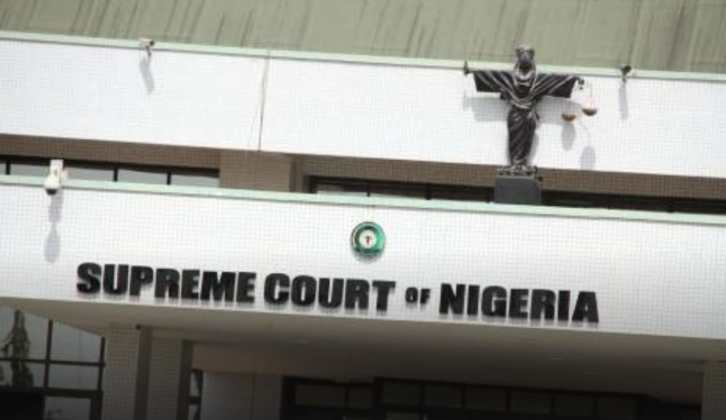
The Supreme Court of Nigeria has affirmed that the President has constitutional authority to declare a state of emergency in any part of the country to avert a breakdown of law and order or a descent into chaos. In a split decision of six to one, the apex court held that the President can, during such an emergency, temporarily suspend elected officials — but only for a limited period.
In the lead judgment, Justice Mohammed Idris stated that Section 305 of the 1999 Constitution empowers the President to take extraordinary measures to restore normalcy once a state of emergency is declared. The Constitution does not explicitly list the kinds of measures that may be taken, leaving their scope to presidential discretion within constitutional bounds.
The President’s exercise of these powers was challenged in a suit filed by Adamawa State and 10 other Peoples Democratic Party (PDP)-led states, which argued that the emergency proclamation in Rivers State — and the suspension of elected officials including Governor Siminalayi Fubara — was unconstitutional.
Justice Idris also upheld preliminary objections raised by the Attorney General of the Federation (AGF) and the National Assembly that the plaintiffs failed to establish a cause of action that would activate the Supreme Court’s original jurisdiction. Consequently, the suit was struck out for lack of jurisdiction. The majority nonetheless proceeded to address the substantive legal questions and dismissed the case on its merits.
Justice Obande Ogbuinya dissented. In his view, although the President can declare a state of emergency, he cannot use that power to suspend elected state officials, including governors, deputy governors, and legislators. The dissent argued that allowing such suspension effectively undermines Nigeria’s constitutional democratic framework.
The legal battle stemmed from President Bola Tinubu’s decision earlier in the year to declare a six-month emergency in Rivers State, during which the governor, his deputy, and members of the State House of Assembly were suspended, and a sole administrator was appointed to run state affairs. The suit before the Supreme Court was one of several legal challenges that emerged over the President’s actions.