
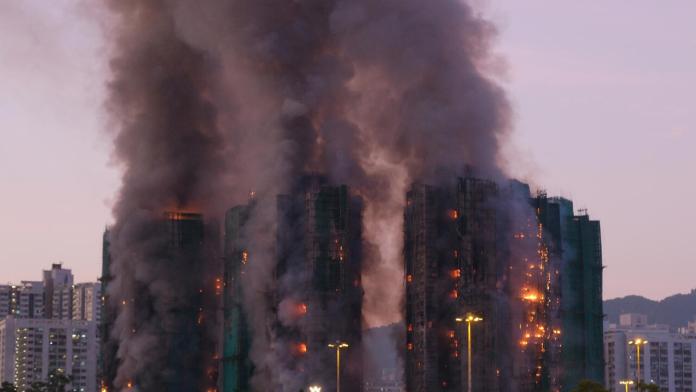
A blaze that ripped through the high-rise housing estate Wang Fuk Court in the Tai Po district has become the deadliest residential fire in Hong Kong in decades, as officials confirmed on Friday that at least 128 people are dead, and roughly 200 remain unaccounted for after emergency operations ended.
Firefighters and rescue crews said they concluded their operations around 10:18 a.m. local time, after battling a massive inferno that engulfed seven of the estate’s eight 32-storey towers. The complex — home to thousands of residents and undergoing renovation — was wrapped in bamboo scaffolding and green mesh, which authorities now suspect helped fuel the rapid spread of the flames.
The blaze broke out on Wednesday afternoon, reportedly igniting on the protective netting around one block. Flames quickly climbed and spread to neighboring towers — a process worsened by highly flammable materials used in the renovation, including plastic mesh and foam window coverings. The National+2 Fire alarms in many buildings failed to activate properly, complicating evacuation efforts.
Firefighting crews laboured for more than 40 hours to extinguish the blaze. Thick smoke, intense heat, and collapsing scaffolding hampered their work, particularly in upper floors where smoke and flames spread rapidly.
• Among the confirmed 128 dead is a firefighter who died in the line of duty.
• At least 79 people were injured, including multiple firefighters.
• Families and rescue workers have begun the grim process of recovering bodies — many are being transferred to mortuaries for identification, while survivors and displaced residents await news of missing loved ones.
• The fire displaced hundreds of residents: according to officials, around 900 people were evacuated to temporary shelters and other accommodation.
Oddly among the casualties are some foreign domestic workers, highlighting the tragedy’s wider social impact: several among the dead and missing are non-local residents.
Authorities have already begun investigations into the causes of the fire and the construction work at the estate. The Independent Commission Against Corruption (ICAC) has launched a full inquiry, and several individuals from the renovation contractor (including directors, project managers, and an engineering consultant) have been arrested on suspicion of manslaughter or gross negligence.
Preliminary findings suggest the exterior materials used in the renovation — notably flammable netting, foam boarding, and plastic mesh — may have violated fire-safety standards, allowing the fire to spread far more quickly than typical residential fires.
Officials have announced immediate safety inspections across other housing estates undergoing renovations to ensure compliance with fire-safety regulations.
In Tai Po and across Hong Kong, the scale of the tragedy has shocked communities. Families of the missing spent Thursday and Friday scouring hospitals, mortuaries, and temporary shelters in hopes of hearing news about loved ones.
Volunteer and grassroots groups swiftly mobilized to offer support — providing food, shelter, information and emotional solace to survivors, evacuees, and relatives of victims. Some are coordinating aid through ad-hoc web applications and social media to help locate missing persons or assist displaced families.
The government announced a relief fund to help victims and survivors, though calls are growing for more systemic reforms to prevent future disasters — especially regarding building-safety regulations and material standards in renovation projects.
The fire at Wang Fuk Court has laid bare deep vulnerabilities in housing safety and regulation enforcement, igniting public outrage and grief across Hong Kong. As investigations continue and the search for missing persons goes on, many await answers not just about this tragedy — but about how to ensure it never happens again.
