
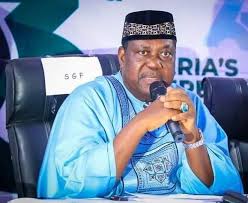
A major political and human-rights controversy erupted this week after the Secretary to the Government of the Federation (SGF), Senator George Akume, issued a comprehensive statement on November 19 addressing the evolution of violent extremism, banditry, and the rising international debate over whether Christian communities in Nigeria are facing genocide.
The nearly 5,000-word briefing—framed as a strategic clarification of Nigeria’s security realities—asserted that claims of a “Christian genocide” are unfounded, arguing instead that both Nigeria’s ideological insurgency in the North-East and the criminal banditry ravaging the North-West have affected Christians and Muslims alike.
But just four days later, on November 23, the statement drew a blistering rebuttal from human-rights advocate Nasiru Jagaba, representing Middle Belt communities, who accused the Federal Government of “erasing” atrocities and suppressing patterns of targeted killings against Christian populations in several states.
Together, the duelling statements have ignited one of the country’s most contentious debates in years—one that intersects national security, religious identity, international diplomacy, and the politics of memory.
SGF: Violence in Nigeria Not Genocide, But a Complex Mix of Terrorism and Economic Banditry
In his detailed briefing, SGF Akume outlined Nigeria’s contemporary security crisis across two primary fronts:
• North-East ideological insurgency, which has transformed over two decades from the teachings of Boko Haram founder Mohammed Yusuf to fracturing factions influenced by Al-Qaeda, ISIS, and later ISWAP.
• North-West banditry, which he described as driven not by religion but by “economic determinism”—including illegal mining, cattle rustling, kidnapping-for-ransom, extortion, and territorial control.
The SGF emphasised that “Christians and Muslims have been equally victimised” and declared that “no credible international organisation has ever classified the crisis as genocide against Christians or any group.”
He linked Nigeria’s instability to the post-2011 breakdown of Libya and Egypt, which flooded the Sahel with weapons and extremist networks, enabling Boko Haram and ISWAP to acquire arms and logistics through AQIM-linked routes.
Akume also highlighted Nigeria’s slow pre-2010 legal response to terrorism, strengthened only after the 2010 Independence Day bombing, which led to the Terrorism Prevention Act and the country’s modern counter-terrorism architecture.
Humanitarian Impact Highlighted, But With Different Interpretations
The SGF, a Benue State indigene and former governor there, underscored recent mass-casualty events such as the June 2025 Yelewata attack in Benue—where at least 100 people were killed—as evidence of Nigeria’s commitment to intervention, reconstruction, and relief.
He argued that recent U.S. pronouncements labeling violence as “genocide” had “inadvertently emboldened opportunistic violent groups,” warning that such rhetoric risks destabilizing ongoing counter-insurgency efforts.
Nigeria’s position, he said, is clear:
the violence is real, devastating, and transnational—but not religiously targeted.
Rebuttal: Middle Belt Advocate Accuses Government of “Strategic Erasure” of Christian Suffering
In a point-by-point response, human-rights advocate Nasiru Jagaba accused the Federal Government of ignoring “patterns of targeted violence” that he says have long been documented by local groups, journalists, survivor networks, and faith-based organisations.
“A responsible government cannot ignore patterns of targeted violence… and in the SGF’s statement, not a single line acknowledges the thousands of Christians killed across the Middle Belt.”
Jagaba listed states where he claims Christian communities have faced systematic attacks: Southern Kaduna, Plateau, Benue, Taraba, Adamawa, Niger, Nasarawa, Kogi, and outskirts of the FCT—arguing that their omission from the government’s narrative is “not accidental, but strategic.”
Accusations of Political Rewriting of History
Jagaba condemned what he called a “political U-turn” by the Benue State Government—once vocal about genocide claims but now aligned with the Federal Government’s stance.
He framed this shift as “betrayal” of victims and “a stain on leadership integrity.”
Claims of Targeted Persecution
The rebuttal accuses the government of suppressing data on:
• attacks on churches and clergy
• forced conversions and abductions of Christian minors
• destruction of Christian-majority villages
• land occupations following attacks
• discrimination in education, employment, and public service appointments
• underdevelopment of Christian-dominated areas in the Middle Belt
Jagaba argues that if Christians are not being targeted, the government must explain why “90% of destroyed villages across Benue, Plateau, Southern Kaduna, and Taraba are Christian-majority communities.”
Challenge to the Government’s Dismissal of Genocide Claims
Responding to the SGF’s insistence on credibility through international institutions, Jagaba countered:
“You cannot lobby the graves. You cannot lobby the burnt churches. Credibility lies with survivors, not with government press releases.”
He accused Abuja of lobbying foreign governments to soften language in their official communications.
Diplomatic Tensions: U.S. Comments Trigger Friction
Both statements referenced recent U.S. commentary on Nigeria’s escalating violence.
The SGF argued that such remarks—characterising attacks as genocide—have “emboldened attackers” and risk internationalising Nigeria’s internal conflicts.
Jagaba dismissed this claim as “absurd,” asking whether terrorists waited for U.S. statements before attacking Agatu, Chibok, Barkin Ladi, Guma, Kajuru, or abducting Leah Sharibu.
He urged Washington and other global institutions to conduct independent investigations rather than rely on government briefings.
A National Debate at a Crossroads
The dueling statements highlight a polarising divide:
• Government narrative:
Violence is multidimensional, not religious; Christians and Muslims suffer equally; international genocide language is inaccurate and dangerous.
• Human-rights narrative:
Christian communities face systematic persecution; the government is engaged in denial; and targeted violence across the Middle Belt fits established patterns of genocide or ethnic-religious cleansing.
At stake are not only domestic politics and community trust, but also Nigeria’s international reputation, counter-terrorism partnerships, and the framing of one of Africa’s deadliest conflicts.
Moving Forward: Calls for Collaboration, Calls for Accountability
While the SGF called for “stronger collaboration” with the United States, deeper intelligence sharing, increased counter-terror financing measures, and enhanced rural security, Jagaba issued his own appeal:
• for international investigations
• for survivor-centered documentation
• for truth-telling
• and for what he described as “an end to political whitewashing of human blood.”
Both agree on one point:
Nigeria is at a precarious moment, and the stakes for national unity—and the credibility of its institutions—have rarely been higher.
● Editor’s Note: Senator George Akume and Nasiru Jagaba’s statements are available in the Opinion Section.