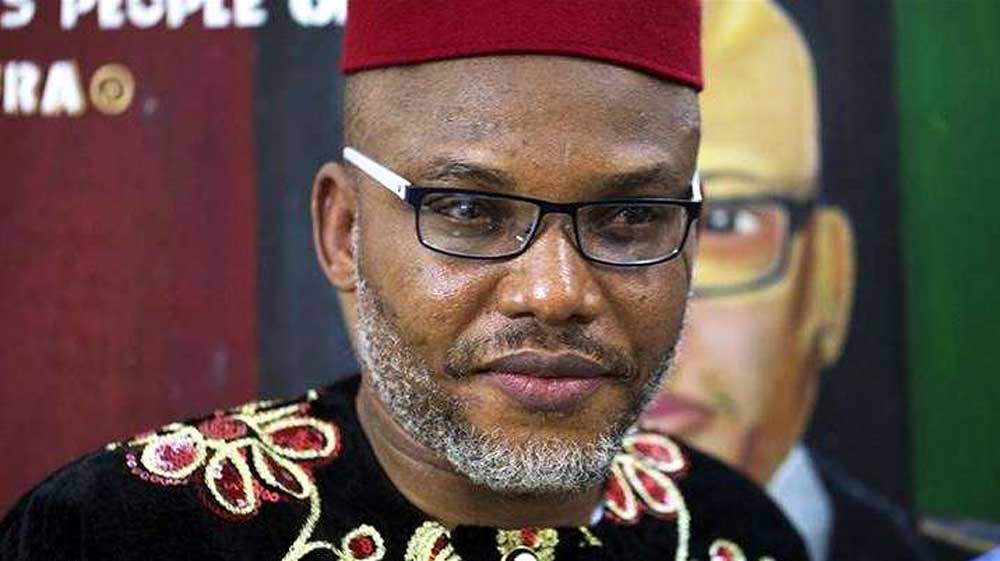
In a major verdict on Thursday, 20 November 2025, a Federal High Court in Abuja, presided over by Justice James Omotosho, found Nnamdi Kanu, leader of the Indigenous People of Biafra (IPOB), guilty on all seven counts of terrorism-related charges brought by the government. The charges include incitement, unlawful association, and acts threatening national security, each carrying a maximum penalty of death.
But Justice Omotosho handed down a life sentence to Kanu.
The judge had earlier found Kanu guilty on all seven terrorism-related charges brought against him, stating that the prosecution’s evidence stood firm and was not effectively challenged.
In delivering the sentence, Justice Omotosho imposed life imprisonment for counts 1, 4, 5, and 6. He further ordered a 20-year jail term without the option of a fine for count 3, and an additional five years without the option of a fine for count 7.
“The court has considered the gravity of the offences. Were it not for certain mitigating factors, the death penalty would have been appropriate in light of the atrocities committed,” the judge said. He added that Kanu had shown no remorse, describing him as “unrepentant, defiant, and oblivious to the harm his actions caused the people of the South East.”
Justice Omotosho noted that he had taken into account a plea from a member of the House of Representatives representing Kanu’s constituency. While he said the plea did little to sway him, he emphasized the need to balance justice with mercy.
“In keeping with the teachings of Jesus Christ, and considering the global shift away from capital punishment, the court will refrain from imposing the death sentence,” he stated. “Life remains sacred.”
Accordingly, he substituted the death penalty with life imprisonment for the four applicable counts. He then confirmed the 20-year and 5-year terms for counts 3 and 7 respectively, and ordered that all sentences run concurrently.
Justice Omotosho delivered the judgment after Kanu, who had repeatedly challenged the court’s jurisdiction, was escorted out by security operatives following what the judge described as “unruly” behaviour. The judge reproached Kanu for disrupting proceedings before announcing conviction on the first count; he indicated that sentencing on all counts would follow.
The Igbo Community in Abuja has called on President Bola Tinubu to use his executive powers to free Kanu. In a statement, they described his prolonged detention as “injustice” and warned that the #FreeNnamdiKanuNow protests risk destabilising the administration.
The Igbo Ministers Commission has argued that Kanu’s rendition to Nigeria from Kenya in 2021 violated international law, undermining the fairness of his prosecution. Daily Post
IPOB itself condemned the trial as unconstitutional, alleging his 2021 arrest was “state-sponsored international banditry,” and again called for his immediate and unconditional release.
Critics have raised serious due process concerns, pointing to the fact that Kanu largely represented himself after parting ways with his legal team, and repeatedly challenged the court’s authority, arguing that the terrorism law used to charge him had been repealed. The
There have also been calls from civil society and international observers for the government to ensure transparency and respect for legal norms in the case, especially given the politically charged nature of the proceedings.
Below is a brief timeline of key events in Kanu’s legal odyssey:
2015: Kanu is first arrested, faces charges including treasonable felony.
2017: He absconds from court while on bail.
June 2021: Re-arrested in Kenya and returned to Nigeria in what his lawyers describe as “extraordinary rendition.” J
une 2021: Placed into custody by the Department of State Services (DSS) in Abuja.
April 2022: A Federal High Court strikes out eight of the 15 counts against him.
October 2022: Court of Appeal orders his immediate release and quashes several charges.
December 2023: Supreme Court reverses the Appeal Court, restoring the 7-count terrorism charge.
March 2025: New judge, Justice James Omotosho, takes over the case, which is reopened “de novo.”
May–June 2025: Prosecution closes its case following scheduled hearings.
July 18, 2025: Court adjourns to 10 October for a ruling on a “no-case submission” by Kanu’s defence.
October 8, 2025: Court orders a medical report to assess Kanu’s fitness to continue trial.
October 23–30, 2025: Kanu begins defence but later fires his lawyers and declines to call witnesses.
November 7, 2025: Judge rules Kanu has waived his right to defend after six days and fixes 20 November for judgment. November 20, 2025: Conviction on all seven counts announced. Today’s verdict.
Significance
The conviction of Kanu is a high-stakes moment in Nigeria’s history, potentially deepening divisions between the federal government and separatist-leaning groups in the southeast.
Many see the trial as a litmus test for rule of law, given the questions around his rendition, the legal basis of the charges, and his decision to forgo a traditional defence.
The result may ignite renewed calls for political solutions to the longstanding Biafra question, especially if the maximum sentence is imposed.
Earlier, tension ran high on Thursday at the Federal High Court in Abuja after Kanu, abruptly disrupted proceedings, forcing trial judge Justice James Omotosho to briefly step out of the courtroom.
The drama unfolded just moments before Justice Omotosho was scheduled to begin delivering judgment in Kanu’s long-running terrorism case, which was being broadcast live from the courtroom.
Trouble started when the judge instructed the court registrar to call the case between the Federal Republic of Nigeria and Nnamdi Kanu. Before the registrar could proceed, Kanu rose to his feet and interjected loudly.
“My lord, there is no judgment today because we have joined issues in the matter,” he declared.
Justice Omotosho cautioned him, responding: “Defendant, there is decorum in court. Let the registrar call the matters accordingly.”
The confrontation escalated when the judge ordered that Kanu’s microphone be taken away. Kanu resisted, prompting Justice Omotosho to walk out of the courtroom briefly. He later returned, and the session resumed.
Cameramen and crew from several television stations — including the NTA, Channels TV, AIT, and TVC — were present with equipment for the live coverage of the proceedings.
Justice Omotosho had earlier fixed November 20 for judgment after ruling on November 7 that Kanu had forfeited his right to present a defence. Kanu had insisted he would not open his defence under what he argued were repealed laws, a position the court dismissed.
The judge held that Kanu had been allotted six days to conduct his defence but failed to utilise the opportunity, thereby waiving his right to do so. He added that the court would have granted an extension if Kanu had opted to open his defence.
Following Thursday’s disturbance, Kanu was removed from the courtroom, and Justice Omotosho proceeded with the long-awaited judgment.