
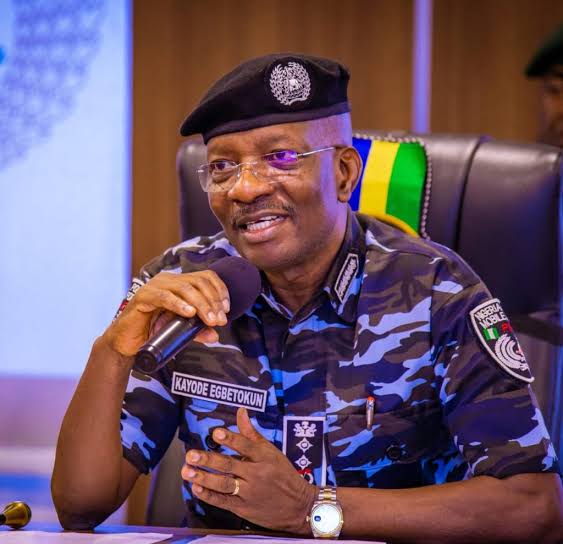
Nigeria needs at least 500,000 to cover its over 236 million population, but unfortunately she has 371800 performing the policing duty. Worse, 100,000 (over 26%) of the available men are busy with protecting very important personalities (VIP).
The issue has reignited concerns over the state of public security in Nigeria: a disproportionate number of the Nigeria Police Force (NPF) personnel appear to be assigned to the protection of Very Important Persons (VIPs), rather than to the general public.
According to a new document published in November 2025 by the European Union Agency for Asylum (EUAA), the NPF is estimated at 371,800 officers serving a national population of about 236.7 million.
When compared to the oft-cited United Nations benchmark of 1 police officer per 450 citizens, Nigeria’s ratio of approximately 1:602 falls well short. The implication: to meet that benchmark, Nigeria would need approximately 511,111 officers, meaning an additional labour-force gap of nearly 190,000 officers.
VIP Protection: A Growing Drain on Resources
The EUAA report draws attention to a longstanding issue in Nigeria: that “more than 100,000 police officers were assigned to the protection of politicians and VIPs, rather than to tasks serving the general population.”
According to earlier analyses, this diversion of policing capacity significantly weakens community policing, crime prevention, and response efforts.
Several key points emerge:
• Between the understaffed force and the heavy deployment to VIPs, many communities—especially rural or marginalised urban areas—are left with minimal or no active police presence.
• The ratio of police to citizens, already low, is effectively worse in many places once VIP protection duties are factored in. Some older reports claim that up to 80 % of certain special units (e.g., the Mobile Police Force) were engaged in VIP tasks rather than their core remit.
• Even though directives have been issued by the IGP to withdraw mobile police from VIP duties (notably in June 2023 and April 2025), implementation appears inconsistent and the problem persists.
The Consequences of a Skewed Deployment
Public Safety at Risk
With fewer officers assigned to general duties, the risk of delayed crime responses, low deterrence, and rising unreported crime grows. The EUAA report states that manpower shortages, corruption and limited resources “have resulted in delayed responses to crimes and numerous communities being left without protection.”
Trust & Accountability
The diversion of police to elite protection also undermines perceptions of fairness in policing. Weak accountability mechanisms compounded by misconduct—arbitrary arrests, extortion and excessive use of force—are flagged in the report. This breeds mistrust between the public and law-enforcement agencies.
Unbalanced Priorities
When state capacity is devoted to protecting the powerful rather than the many, it raises questions about resource allocation and equity. As a senior presidential adviser (Hadiza Bala‑Usman) recently put it: “One of the most disturbing things for me is when VIPs arrive somewhere with so many policemen trailing them, while the areas that actually need security are left unattended.” The call was made to enable private security firms to take on some of the load, freeing up public forces for wider security tasks.
Root Causes: Beyond Numbers
It’s not just about manpower. Several interlinked factors exacerbate the situation:
• Under-funding & Equipment Shortages: Many commentators note that the NPF’s strength remains static (around 370,000) even as the population grows and security needs intensify.
• Deployment Priorities: When large numbers of officers are assigned to VIP protection or corporate/private security tasks, conventional policing suffers.
• Governance & Oversight Gaps: Weak accountability structures mean that poor conduct among officers goes unchecked; this undermines morale, public trust and the effective use of existing resources.
• Growing Security Challenges: With insurgency, banditry, kidnapping and communal violence on the rise, the pressure on the police is enormous. The EUAA’s Security Situation report notes “the country’s military and police forces overstretched.”
Voices Calling for Change
• In August (2025), Hadiza Bala-Usman, President Bola Tinubu’s Special Adviser on Policy and Coordination, argued the deployment of mobile police to VIPs must stop, and that the enabling legislation—the Police Act—must be reviewed to permit more appropriate security arrangements.
• Earlier, in June 2023 and April 2025, the IGP (Kayode Egbetokun) ordered the withdrawal of mobile police operatives from VIP duties. Despite the directives, change appears partial.
What Needs to Happen
• Transparent Audit of Deployment: A clear publicly-available breakdown of how many officers are assigned to VIP protection versus general duties would provide accountability and a basis for reform.
• Reprioritise Policing Tasks: Shift the focus of public policing towards community safety, crime prevention, and rapid response — rather than routine escorting of the elite.
• Strengthen Private Security Regulation: Allow private security firms to legitimately handle non-state actor protection tasks, thereby enabling state policing to focus on public safety.
• Expand & Modernise the Force: Recruit the additional ~190,000 officers indicated as needed to meet international benchmarking; ensure training, equipment, welfare and oversight keep pace.
• Improve Governance & Oversight: Strengthen accountability mechanisms to reduce misconduct, corruption and misuse of police resources.
• Regional / Localised Policing Solutions: Given the size and diversity of Nigeria, consider measures such as state-level policing or localised community policing units to better cover underserved areas.
Nigeria’s police-citizen ratio is alarming enough; when that is compounded by the high proportion of officers devoted to VIP protection and the inadequate deployment for general public security, the consequences are serious. The EUAA’s finding that “more than 100,000 officers” are dedicated to VIP protection is a stark reminder that reform is needed — not only in numbers, but in priorities, governance and deployment. The security of ordinary Nigerians must become the main focus of the NPF if the many, rather than the few, are to be protected.
A comparative look at policing-ratios and security capacity, drawing on international and regional data to contextualise the situation in Nigeria Police Force (NPF).
Global & Regional Benchmarks
According to the United Nations Office on Drugs and Crime (UNODC), on average around 400 inhabitants per police officer is found globally—though there is wide variation between regions.
In sub-Saharan Africa, the challenge is particularly stark: many countries have far fewer officers per citizen than the global average. For example, in one survey several African countries had ratios of 1 officer to over 1,000 citizens.
Country-specific Comparisons
Here are some comparative numbers for selected countries:
Kenya1 : 688 in 2021 (i.e., one officer for every 688 citizens). This improved from ~1 : 978 in 2009.
South Africa~1 : 347 (approx. 288 officers per 100,000 people) according to a BusinessTech article. South Africa is among the better-resourced in the region, yet still facing severe crime-load.
The Nigeria stats report varies by source; one older source gives ~205 officers per 100,000 (≈1 : 488).
Another source states ratio ~1 : 722 in earlier published data. Numbers are dated and there is disagreement regarding ‘active’ vs ‘all-staff’.
What this means for Nigeria
If the NPF (Nigeria Police Force) has ~371,800 officers (as your the EU report states) and Nigeria’s population is ~236.7 million, the ratio is ~1 officer for every 637 citizens (or ~156 officers per 100,000). This place Nigeria worse than many peer countries in Africa and well below the global average.
For Kenya’s 1 : 688 ratio vs South Africa’s ~1 : 347, Nigeria’s ratio (if indeed ~1 : 600+) suggests a heavier burden per officer.
The benchmarking numbers often cited (e.g., 1 : 450) are not official UN standards, but rather heuristics. For instance, AfricaCheck notes that there is “little evidence that the UN has ever recommended a specific ratio.”
Key Takeaways
The ratio of police to citizens is a rough indicator of capacity—but it does not capture quality of policing, distribution (urban vs rural), equipment, training or morale.
Nigeria’s policing-ratios are among the poorer in comparison with some regional neighbours and global averages.
Given the additional factor mentioned (100,000+ officers assigned to VIP protection rather than general policing), the ‘effective’ ratio for community policing may be even worse than the headline number.
The comparative data emphasise how structural constraints—lack of officers, weak distribution, equipment shortages—are common across Africa. The difference for Nigeria is the scale of population and security challenges.