
The Federal Government (FG) has reaffirmed its commitment to handling the escalating diplomatic standoff with the United States via dialogue rather than confrontation, even as Washington signals potential military involvement over claims of mass killings of Christians.
But reports in New York Times suggests the U.S. military has draftEd airstrikepllans for Nigeria after Trump issued an order.
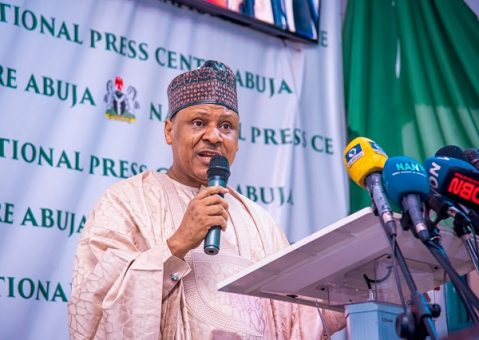
Speaking in Abuja on Thursday, as done in previous engagements with the media, Mohammed Idris, Nigeria’s Minister of Information and National Orientation, made clear that the government views the U.S. allegations as a serious matter but insists the characterisation of Nigeria’s security crisis as a “genocide” of Christians is misleading. The comments came amid a deepening diplomatic row triggered by U.S. threats of military action if Nigeria fails to act.
The report on Wednesday says U.S. military has developed contingency plans for possible airstrikes in Nigeria after Trump directed the Pentagon to “prepare to intervene” to protect Christians from terrorist attacks.
U.S. Africa Command, or AFRICOM, submitted several operational options to the Pentagon following an order from Defense Secretary Pete Hegseth to create a framework consistent with Trump’s directive, the report said, citing senior military officials.
The proposed plans were divided into “heavy,” “medium,” and “light” options, each outlining a different level of U.S. involvement in Nigeria’s fight against insurgent groups.
Under the “heavy” option, the United States would deploy a carrier strike group to the Gulf of Guinea, supported by fighter jets and long-range bombers targeting militant positions in northern Nigeria.
The “medium” option calls for the use of MQ-9 Reaper and MQ-1 Predator drones to conduct targeted strikes on insurgent camps and mobile convoys, with intelligence support to ensure precision.
The “light” option focuses on intelligence sharing, logistics, and limited joint operations with Nigerian forces against Boko Haram and other extremist groups accused of killings, kidnappings, and attacks on churches.
Pentagon officials reportedly cautioned that limited strikes or drone raids would be unlikely to defeat Nigeria’s complex insurgency without a broader campaign similar to U.S. operations in Iraq or Afghanistan — a step Washington is not currently prepared to take.
The position taken by Mohammed Idris differs fundamentally with that of Christians in the North and especially in the north-central zone, often referred to as the Middle-Belt, who insist vehemently that the government is less than truthful and is seeking to stave-off US anger after it had watched them targeted, slaughtered and hundreds of their communnaturedestroyed and emptied.
The trigger for the tensions between and Nigeria and US began after the U.S. government, through statements by Donald Trump and Pentagon-linked sources, accused Nigeria of failing to halt widespread killings of Christians, and ordered the Pentagon to prepare contingency military options.
The FG rejected the designation of being on a “Country of Particular Concern” list for religious freedom violations, calling it based on “faulty data” and mis-characterises the nature of the violence.
The National Assembly has been mobilising to craft an official response — the Senate set up a 12-member ad-hoc committee to compile a position paper and engage U.S. lawmakers directly, even though it has failed woefully to assuage the Christians in the middle-belt, especially Kaduna, Plateau, Benue. Others in Adamawa, Borno, Gombe, Yobe, Bauchi, Nasarawa claim they have quietly suffered the onslaught for decades.
Idris acknowledged Nigeria’s severe security challenges but insisted the violence is not a one-sided campaign against Christians. He stressed that the victims include both Christians and Muslims, and that framing the crisis solely through a religious lens “fundamentally misrepresents the complex nature of the situation.”
He said the government prefers to resolve the matter through “diplomatic channels” rather than escalate to deeper conflict.
Foreign Minister, Yusuf Tuggar, reinforced that viewpoint, stating in Berlin that “state-backed religious persecution is impossible under our constitution.”
But many put part of the blame for the escalation of the tension on President Bola Tinubu and Tuggar’s desk, having failed for two years to appoint ambassadors that can interface with countries.
Analysts and Nigerian officials note that violence in Nigeria is driven by a complex mix of terrorism (e.g., Boko Haram, local insurgents), banditry, communal and resource-based conflict — not simply religious affinity, though some admit it can not be ruled out.
The government argues that the narrative of “Christian genocide” underplays the fact that Muslims also suffer large-scale attacks in the north and other regions. Opponents, however, quickly point out that nearly 100 per cent of the drivers of the violence are Islamists and Muslims.
Critics at home say the government should still acknowledge failings: for example, one opposition voice pointed out Nigeria must “admit its failings… and assure Nigerians and the international community of its commitment.”
With the U.S., hiding behing the bloodletting that has escalated in last decade and half to pursue other agenda; and signalling possible military or aid withdrawal action, Nigeria is keen to manage the damage to bilateral relations.
The Nigerian government’s decision to emphasise diplomacy reflects:
• the desire to preserve national sovereignty and avoid external military intervention.
• the need to correct what it sees as “misleading international narratives” that could hurt Nigeria’s global standing and economy.
• A recognition that security co-operation with the U.S. and other partners remains crucial — but must happen on terms that respect Nigeria’s constitutional and sovereign frameworks.
Whether the U.S. follows through on military options or aid cuts. The declarations to date suggest readiness but not yet deployment.
Other issues to watch out for are: how Nigeria’s Senate committee report and diplomatic outreach to U.S. lawmakers will influence congressional perceptions;
* whether Nigeria steps up transparency, investigations and data collection on security incidents to bolster its counter-narrative abroad;
*how this plays domestically: pressures from civil society, religious groups, and opposition actors may shape how the government frames the issue internally.
In short: Nigeria is pushing back strongly against U.S. allegations of a Christian “genocide” and is opting for diplomacy in hopes of averting intervention. But the underlying security crisis remains urgent and multifaceted, and the country faces both internal and external pressure to respond effectively.
Here is a detailed timeline of the key statements, decisions and diplomatic steps by both Nigeria and the United States surrounding the dispute over alleged Christian-targeted killings and the threat of U.S. military involvement. This timeline is drawn from recent public reporting.
Timeline: Nigeria – U.S. dispute over alleged Christian killings
Late 2024–2025: Rising reports of killings and displacement in Nigeria with various NGOs reporting large numbers of Christians and others killed or displaced in parts of Nigeria.
For example, one report claims over 7,000 Christians killed in the first 220 days of 2025. These figures become part of the U.S. narrative.
31 October 2025: U.S. designates Nigeria as a “Country of Particular Concern” (CPC) for religious freedom. The U.S. government formally lists Nigeria among countries it says are failing to act to protect religious freedom. This designation signals heightened U.S. concern and raises the stakes politically.
1 November 2025: U.S. President Donald Trump threatens military action over alleged Christian killings. Trump posts on social media that if Nigeria continues to allow the killing of Christians “we will go in … guns-a-blazing,” and instructs the U.S. Department of War (Pentagon) to prepare for possible action. This marks a dramatic escalation from diplomatic concern to talk of military intervention.
2 November 2025: Nigeria rejects U.S. threat of military action. A spokesperson for President Bola Ahmed Tinubu, Daniel Bwala, states that the U.S. cannot unilaterally carry out an operation in Nigeria and describes the threat as “misleading reports” and part of Trump’s negotiation style. Nigeria emphasises sovereignty and rejects the framing of a Christian-only genocide.
3–4 November 2025: Nigerian security leadership further refutes persecution claims. The Chief of Defence Staff, Lt Gen Olufemi Oluyede, states “there are no Christians being persecuted in Nigeria” and frames the issue as terrorism, not religious targeting. Meanwhile Nigerian officials reaffirm the violence affects all faiths.
4 November 2025 onward: U.S. lawmakers introduce resolutions and ramp up pressure. U.S. representatives such as Riley Moore push for resolutions condemning the violence in Nigeria and calling for U.S. diplomatic, economic and security action. This broadens the dispute from executive threats to legislative activism.
Present – Diplomacy intensifies: Nigeria emphasises diplomatic channels and active engagement. Minister of Information Mohammed Idris states the federal government is committed to resolving the matter via diplomacy, not confrontation.