
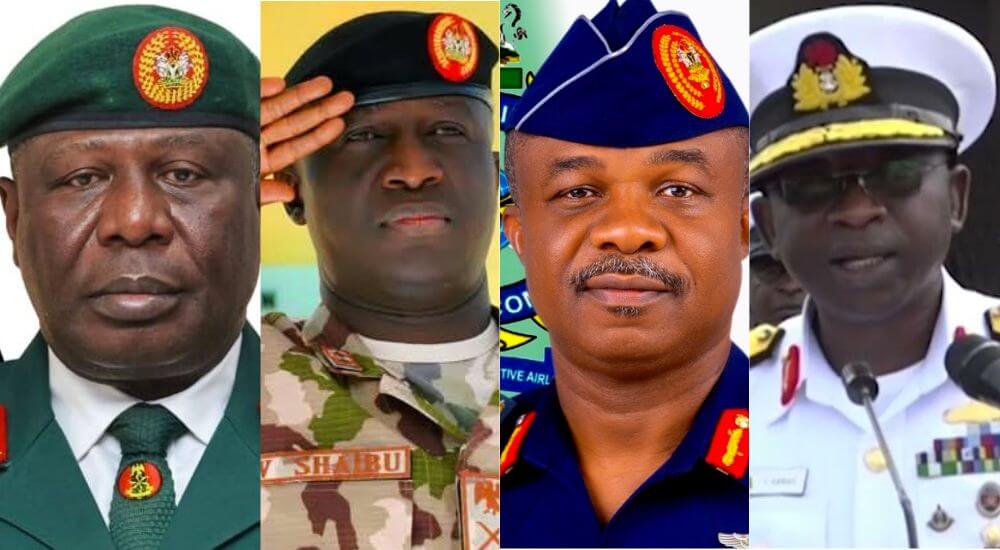
In a sweeping overhaul announced Wednesday, the Senate of the Federal Republic of Nigeria confirmed a fresh lineup of service chiefs, including the appointment of Rear Admiral Idi Abbas as the new head of the Nigerian Navy. What might have been a routine exercise quickly turned dramatic when the Navy chief openly dismissed the establishment of a separate Coast Guard and announced bold plans for high-tech maritime operations.
President Bola Ahmed Tinubu’s letter to the Senate, delivered on October 27, asked for swift approval of key appointments designed to “deepening professionalism, boosting morale, and enhancing inter-agency coordination in national security operations.”
On Wednesday Lieutenant General Olufemi Oluyede was confirmed as Chief of Defence Staff; Major‑General Waidi Shaibu takes over as Chief of Army Staff; Air Vice Marshal Kennedy Aneke becomes Chief of Air Staff; and Rear Admiral Idi Abbas assumes the post of Chief of Naval Staff.
Senate President Godswill Akpabio described the proceedings as a constitutional duty to entrust the nation’s defence to “the most competent, patriotic and disciplined officers.”
A Navy Chief’s Vision: Tech, Territory—and No Coast Guard
In his screening appearance, Rear Admiral Abbas outlined his priorities: enhanced drone surveillance, tighter control of offshore oil-theft operations and a re-focus of resources on the Navy’s existing patrol structures rather than creating a new Coast Guard.
According to his profile, Abbas has a long record of maritime operations, including such posts as Maritime Guard Commander at Nigerian Maritime Administration and Safety Agency (NIMASA) and Commander Task Group for Operation Tsare-Teku.
He told the committee the Navy would “deploy modern technology, including drone surveillance, to enhance maritime security and curb criminal activities along the nation’s waterways.”
On the proposed creation of a separate coast guard, he stated: “There is no need for such a body since the Navy already performs coast guard duties… Creating another agency would only duplicate functions.”
The stance echoes earlier opposition from a parliamentary committee, which last January told proponents that a Coast Guard would be counter-productive because the Navy was “well-rooted in maritime security in the country.”
Why the Coast Guard Debate Matters
The Gulf of Guinea and Niger Delta regions continue to face serious threats: piracy, oil theft, kidnapping and vessel hijackings remain major national security concerns. Abbas underscored that many of the illegal activities happen in hard-to-reach areas and said that with drone technology, the Navy hopes to monitor and interdict more effectively.
However, the rejection of a new Coast Guard raises questions about whether existing structures can be adequately re-equipped and staffed to meet the challenge without duplication. Resources directed at a new agency might instead be channelled into strengthening the Navy’s operational platforms, as the new CNS proposes.
Meanwhile, Chief of Defence Staff Oluyede, whose biography shows that he assumed the post of Chief of Army Staff in late 2024, described his former role as “one of the most challenging yet rewarding periods” of his career, reflecting the breadth of Nigeria’s security threats — from terrorism to cybercrime.
He emphasised that security is “not a task for the military alone—it requires the cooperation of every Nigerian.”
On his part, Major‑General Waidi Shaibu (Chief of Army Staff) described his more than 30 years of service and said that his career has given him the training and command experience to lead the Army with “renewed focus and energy”.
He pledged to “strengthen special forces training and enhance the Army’s strike capability, both day and night”.
He committed to ensuring that “personnel receive what is rightfully due to them” — signalling a focus on troop welfare.
The Air Chief, Air Vice Marshal Kennedy Aneke vowed to build a “combat-ready, disciplined and intelligent” Air Force, stating he sees the role as a “sacred trust” between the Air Force and Nigerians.
“As the Chief of the Air Staff, my duties are very clear, direct and simple to secure the lives, liberties and aspirations of Nigerians through the instrument of air power … This is not merely a professional mandate. It is a sacred trust between the Nigerian Air Force and the people we serve.”
Aneke emphasised the importance of technology: “Some of the things a Super Tucano can do, a drone can now do better, faster and without risking lives.”
On funding and the cost of operations:
“The Armed Forces is that part of government which you must spend money on and hope not to use. If you do not have it, you are a chicken waiting for the hawk. But if you have it, you can look anyone in the face and defend your country with pride.”
He promised deeper inter-service cooperation: “I will energise and strengthen collaboration among all the services. Together, we will fight as one force for one nation.”
What Lies Ahead
The new leadership team faces immediate expectations from President Tinubu and the Senate to deliver results in an environment of rising insecurity.
For the Navy, the task is substantial: implementing drone surveillance, strengthening inland water patrols (such as the newly noted Special Operations Command in Makurdi/Benue basin), and stopping offshore tankers used for crude theft.
At the same time, institutional tensions may flare between those who favour a specialised coast guard agency and those who support a unified naval command.
The success or failure of the new service chiefs will be closely watched—and may define Nigeria’s maritime security posture for years to come.
With fresh faces now steering Nigeria’s armed forces, the message from Abuja is unmistakable: the security architecture needs bold reform. Rear Admiral Idi Abbas’s rejection of a Coast Guard sets a tone of consolidation rather than expansion. Whether his high-technology, efficiency-led vision can succeed where past efforts have struggled will be a key measure of his tenure. For now, the shake-up signals both ambition and urgency—towards the sea, the creeks, and the contested waters of Nigeria.