
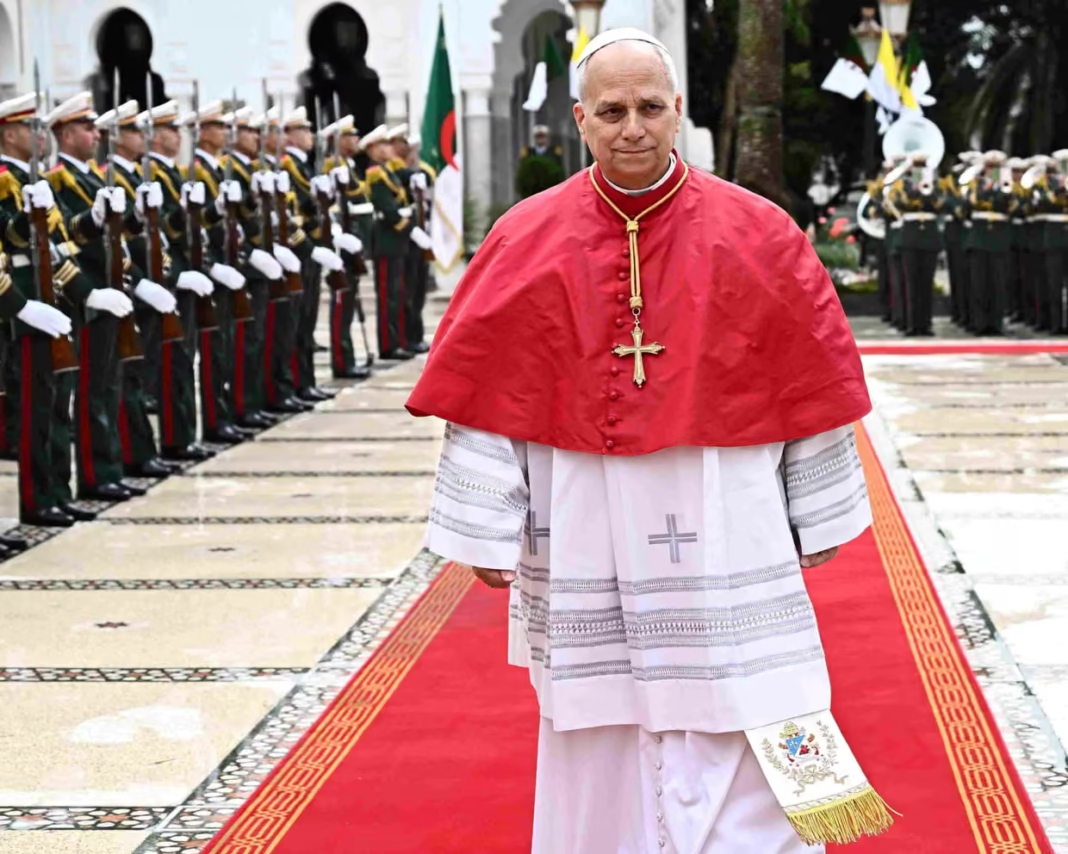
A sharp and increasingly personal disagreement has erupted between Pope Leo XIV and Donald Trump, highlighting deep divisions over war, immigration, and the moral role of leadership in global affairs.
The dispute intensified this week after President Trump publicly criticized the pontiff, calling him “weak on crime” and “terrible for foreign policy” in a social media post. His remarks came in response to the Pope’s repeated condemnation of ongoing military conflicts, particularly the U.S.-backed war involving Iran.
Speaking to reporters while en route to Africa, Pope Leo dismissed the attack and struck a defiant tone, declaring he had “no fear” of the Trump administration and would continue to speak out against violence. He emphasized that his stance was rooted not in politics but in Christian teaching, insisting that the Church must advocate for peace and dialogue.
Clash Over War and Morality
At the heart of the disagreement is the Pope’s outspoken opposition to war. In recent days, he has described global conflict as “madness” and warned against what he called a “delusion of omnipotence” among world leaders. He has also condemned rhetoric that describes military action in religious terms, stressing that “God does not bless any conflict.”
Although the Pope has rarely mentioned Trump by name, his comments have been widely interpreted as criticism of U.S. policy. He previously labeled threats to destroy Iran’s civilization as “truly unacceptable,” urging leaders to pursue diplomacy instead of force.
President Trump, however, has defended his policies, arguing they reflect his electoral mandate. He has accused the Pope of aligning with liberal political views and interfering in matters of state.
The war of words has taken an increasingly provocative turn. Following his criticism, Trump posted an AI-generated image portraying himself in a Christ-like role, a move that drew widespread attention and controversy.
Meanwhile, Pope Leo has maintained a measured response, insisting his message is universal rather than personal. “I don’t want to get into a debate,” he said, while cautioning against the misuse of religious teachings for political ends.
The clash reflects strains between the Vatican and Washington. Disagreements over immigration policy, military strategy, and diplomatic norms have been building for months, with reports of tense exchanges between U.S. officials and Vatican representatives.
There are even indications the Pope may avoid visiting the United States while Trump remains in office, underscoring the depth of the divide.
Observers say the confrontation is unusual both for its public nature and its intensity. While past popes have disagreed with political leaders, direct personal exchanges of this kind remain rare.
Despite the escalating rhetoric, Pope Leo has reaffirmed his commitment to promoting peace and supporting those affected by war. For now, neither side appears willing to back down, leaving the dispute as a striking example of the intersection between faith, politics, and global power.
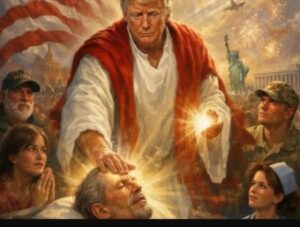
Trump elicited renewed public debate after posting an AI-generated image of himself styled as Jesus Christ on his social media platform, Truth Social.
The digitally created image depicts Trump dressed in flowing white robes and surrounded by a radiant, almost divine glow. He appears to be performing a healing gesture, laying hands on a figure before him – an act commonly associated with religious iconography of Christ.
Adding to the dramatic composition, the scene includes angel-like figures and uniformed soldiers hovering in the air, suggesting a blend of spiritual and militaristic symbolism. In the background, fighter jets streak across the sky while bursts of fireworks illuminate the scene, contributing to its theatrical tone. The iconic Statue of Liberty is also visible, anchoring the imagery in an American setting.
The post has drawn mixed reactions online, with critics calling it provocative and inappropriate, while supporters view it as symbolic or satirical. The use of AI-generated visuals in political messaging continues to raise questions about the boundaries between expression, technology, and public perception.
