
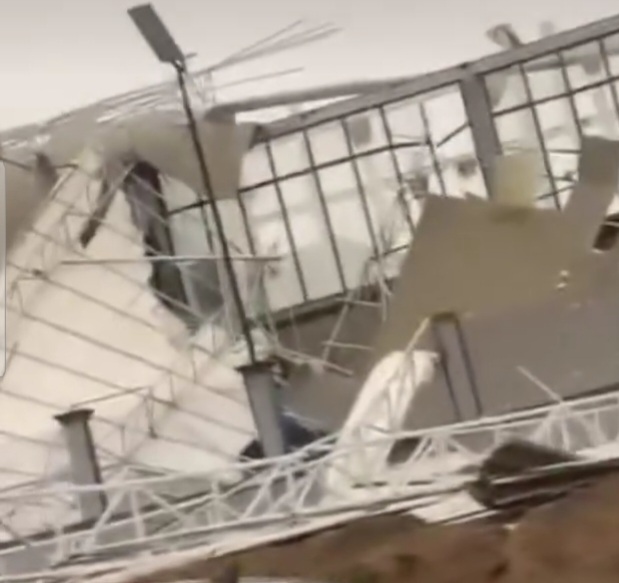
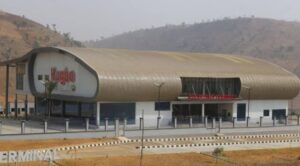
Barely nine months after it was unveiled with fanfare as a cornerstone of modern urban transport, the Kugbo Bus and Taxi Terminal – one of the Federal Capital Territory’s most ambitious infrastructure projects – has suffered partial destruction following a violent Tuesday afternoon rainstorm.
The storm, which began around 3:30 p.m., ripped through sections of the terminal’s roofing, scattering debris across the busy Abuja–Keffi Expressway and triggering hours-long traffic gridlock. Eyewitnesses described scenes of confusion as motorists struggled to navigate fallen materials while some residents attempted to clear the obstruction.
Officials confirmed that no casualties were recorded, though the incident also caused minor damage to nearby infrastructure, including the Nyanya pedestrian bridge.
A Project of Promise
The Kugbo terminal is part of a trio of high-capacity transport hubs conceived in 2024 under the Federal Capital Territory Administration (FCTA) to modernise Abuja’s chaotic public transport system.
Construction of the Kugbo, Mabushi, and Central Business District terminals began in July 2024 under the supervision of FCT Minister Nyesom Wike. The facilities were designed to address long-standing issues such as unregulated transport operations and the menace of “one-chance” robberies.
By June 2025, the Kugbo terminal was officially commissioned during activities marking President Bola Tinubu’s second year in office. At the event, the administration described the terminal as a “world-class” facility equipped with surveillance systems and structured passenger management to improve safety and efficiency.
The contractor, Planet Project Ltd., said the Kugbo and Mabushi terminals were each designed to process over 10,000 passengers daily and accommodate about 120 buses for intercity and intracity travel.
From Commissioning to Inactivity
Despite its high-profile launch, the Kugbo terminal never became operational.
By early 2026, the facility – along with its counterparts – remained idle, awaiting approval from the Federal Executive Council (FEC) for a Public-Private Partnership (PPP) management model.
Minister Wike repeatedly explained that while construction had been completed, the scale and cost of the operational contracts required presidential and FEC approval, delaying commissioning for public use.
This prolonged inactivity drew criticism from residents and observers, who saw the terminals as expensive but underutilised assets. Reports also began to surface pointing to early signs of deterioration, including loose fittings and maintenance concerns at the Kugbo site.
The Storm and Its Aftermath
Tuesday’s rainstorm appears to have exposed structural vulnerabilities.
According to reports, powerful winds lifted sections of the terminal’s roofing and flung them onto adjoining roads, disrupting traffic and raising fresh questions about construction quality and resilience.
Scavengers were seen carting away parts of the damaged structure, underscoring concerns about site security – an issue previously flagged by observers.
In an official statement, the FCTA confirmed the incident and said security personnel had been deployed to restore order and ensure free flow of traffic. Authorities also pledged immediate repairs.
The Kugbo terminal was envisioned as a critical piece of Abuja’s urban mobility reform – part of a shift toward structured, secure, and high-capacity public transport systems.
President Tinubu had described the terminals as a direct intervention against transport-related crimes and inefficiencies, promising a safer commuting environment for residents.
However, the combination of delayed operations and now structural damage has cast a shadow over that vision.
For many Abuja residents, the incident reinforces concerns not just about project execution, but also about maintenance culture, infrastructure durability, and governance processes that leave completed projects unused for extended periods.
The FCTA has assured the public that repairs will be carried out swiftly. Yet, beyond immediate fixes, the incident raises deeper questions:
• Why did a newly built, high-value infrastructure succumb so quickly to weather conditions?
• Could earlier reports of structural issues have prevented the damage?
• And when will the terminal finally begin operations?
Until those questions are addressed, the Kugbo Bus Terminal stands as both a symbol of ambition – and a cautionary tale of the gap between infrastructure delivery and sustainable functionality.
