
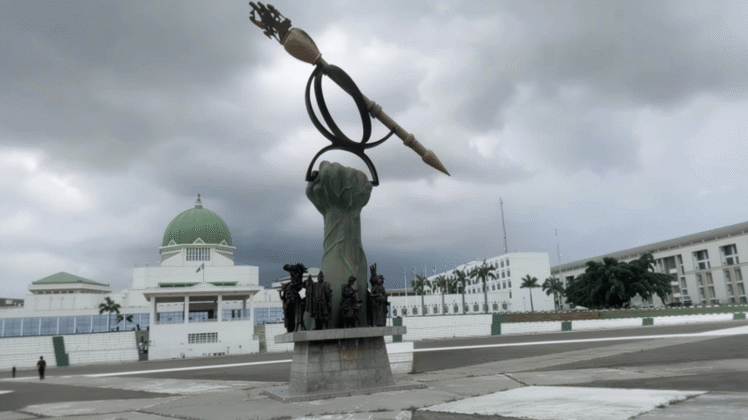
Nigeria’s National Assembly has approved a ₦68.3 trillion budget for the 2026 fiscal year, marking one of the largest spending plans in the country’s history and signalling an aggressive push toward infrastructure expansion and economic consolidation.
The approved figure represents a significant upward revision of over ₦9 trillion from the initial proposal of about ₦58.47 trillion submitted by President Bola Ahmed Tinubu in December 2025.
The increase followed a formal request by the President to accommodate outstanding commitments from previous fiscal cycles, particularly legacy capital projects carried over from 2025.
At the core of the adjustment is ₦5.71 trillion allocated to settle these legacy obligations, aimed at ensuring contractors are paid and ongoing infrastructure projects are completed without disruption.
Lawmakers said the revised budget also includes funding for transport infrastructure, health, and institutional development, reflecting the administration’s focus on long-term economic growth.
Breakdown of the ₦68.3 Trillion Budget
The approved fiscal framework is structured as follows:
• ₦32.29 trillion – Capital expenditure
• ₦15.43 trillion – Recurrent (non-debt) spending
• ₦15.8 trillion – Debt servicing
• ₦4.8 trillion – Statutory transfers
The heavy allocation to capital projects underscores a policy shift toward development-driven spending, with lawmakers emphasizing that capital expenditure now outweighs non-debt recurrent spending.
The 2026 appropriation has been officially described as the “Budget of Consolidation, Renewed Resilience and Shared Prosperity.”
According to the National Assembly, the plan is designed to sustain ongoing economic reforms, including subsidy removal, tax restructuring, and exchange rate adjustments introduced by the Tinubu administration.
Fiscal projections embedded in the budget include:
• Oil benchmark: ~$60–$64.85 per barrel
• Production target: ~1.84 million barrels/day
• GDP growth projection: ~4.68%
• Inflation target: ~16.5%
In a related move, lawmakers approved an extension of the 2025 capital budget implementation to June 30, 2026, to allow Ministries, Departments, and Agencies (MDAs) to complete ongoing projects.
This decision reflects persistent challenges with budget execution timelines, a longstanding issue in Nigeria’s fiscal management.
To finance the ambitious plan, the government is expected to rely on a mix of:
• Increased oil revenues
• Tax reforms and improved revenue collection
• Domestic and external borrowing
Notably, the National Assembly also approved multi-billion-dollar external borrowing, reinforcing concerns about Nigeria’s rising debt burden.
Debt servicing alone accounts for nearly ₦16 trillion, highlighting the growing cost of financing government obligations.
While the government maintains that the budget will stimulate growth and close infrastructure gaps, analysts warn of mounting fiscal risks.
Earlier projections (before the upward revision) placed the deficit at about ₦23.8 trillion (4.28% of GDP), suggesting that the expanded budget could push borrowing needs even higher.
With revenues historically underperforming, concerns are mounting that:
• The deficit could widen significantly
• Debt servicing may crowd out development spending
• Fiscal sustainability could weaken if revenue reforms lag
The 2026 budget reflects a delicate balancing act:
• On one hand, it signals strong commitment to infrastructure development and economic expansion
• On the other, it exposes structural weaknesses in revenue generation and rising debt dependence
Government officials insist the spending plan is necessary to consolidate recent economic reforms and sustain growth, but critics argue that without substantial improvements in revenue performance, the ambitious framework may face implementation constraints
The success of the ₦68.3 trillion budget will ultimately depend on:
• Revenue mobilisation efficiency
• Oil market performance
• Debt management discipline
• Execution capacity of government agencies
As the country moves deeper into a reform-driven economic phase, the 2026 budget is likely to serve as a critical test of fiscal discipline and policy credibility.
