
Beneath the fading light at the Yakubu Gowon Airport in Heipang, grief arrived before the President.
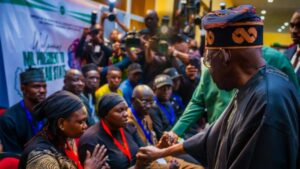
Women clutched photographs. Men spoke in hushed anger. And somewhere in the crowd, a mother who had become the face of the tragedy – captured in a viral video holding the lifeless body of her son, Promise – waited to be heard.
When Bola Ahmed Tinubu finally spoke, his voice carried both urgency and restraint.
“I know the pain,” he said, turning toward the woman. “I saw how you held on to your son… Only God can give you comfort.”
Others video of the distraught mother lamenting her been left alone in the world, and during Late Promises’ burial emerged:
But the setting – a departure lounge rather than the scarred streets of Anguwan Rukuba – would soon ignite a national debate.
The President’s visit came days after coordinated violence tore through communities in Plateau State.
On March 29, gunmen stormed Anguwan Rukuba in Jos North, killing nearly 30 people. What followed was a deadly chain reaction: retaliatory attacks along the Jos–Bauchi highway, panic in nearby settlements, and fresh shootings in Heipang and Riyom.
Among the dead was 27-year-old NYSC member Haruna Ibrahim—killed and burned by a mob on what should have been the eve of his Passing Out Parade.

“It was meant to be a celebration,” said resident Peter Ganchok. “Instead, it became horror.”
Students fled off-campus housing as gunfire echoed near Plateau State Polytechnic. Entire communities – Nassarawa Gwom, Barkin Ladi, Jos South – braced for more violence.
For many, the attacks were not isolated. They were part of a decades-long cycle of ethno-religious conflict that has repeatedly scarred Plateau State.
A PRESIDENTIAL DETOUR
The official explanation for the airport meeting was logistical – and diplomatic.
According to a State House statement, President Tinubu had earlier hosted Chadian President Mahamat Idriss Déby Itno in Abuja for high-level talks on cross-border security. The meeting ran longer than expected, delaying his departure.
By the time his aircraft touched down in Jos, another problem emerged: the airport runway lacked navigational aids for night operations. With less than an hour before dusk, a 40-minute road trip into the city—and back—was deemed too risky.
Officials made a swift decision: bring the victims to the President.
Inside a hall near the runway, Tinubu met survivors, traditional rulers, and security chiefs – including the Chief of Army Staff and Inspector General of Police, who had already visited Rukuba.
Behind the scenes, a federal team had been deployed ahead of him to assess the situation and begin community engagement.
“NOT JUST TO CONSOLE”
Despite the constraints, the President sought to project resolve.
“I don’t want to come here just to commiserate,” he said. “I want to establish peace.”
He promised justice for victims, invited community leaders to Abuja for further dialogue, and unveiled a plan to deploy 5,000 AI-enabled surveillance cameras across Jos to track perpetrators and prevent future attacks.
He also emphasized that peace must be negotiated with communities—not imposed from above.
For some in the hall, the message resonated. The meeting, broadcast live, offered a rare moment of direct engagement between victims and the presidency.
Outside the airport, however, criticism grew louder.
Many Nigerians questioned why the President did not visit the affected communities or hospitals. The brevity of the visit – reportedly under an hour – fueled perceptions of detachment.
Former Vice President Atiku Abubakar was among the most vocal critics, calling the visit “insensitive” and “choreographed.”
In a sharply worded statement, he argued that transporting grieving victims to the airport reduced a human tragedy to political optics.
“A leader who cannot stand with his people in their darkest hour cannot convincingly claim to be fighting for their safety,” he said.
The criticism deepened after reports that the President referenced time constraints linked to darkness at the airport and his onward travel plans.
Government officials insist the criticism overlooks operational realities: aviation safety limits, tight diplomatic schedules, and urgent security coordination.
They argue that Tinubu’s visit was never meant to be symbolic—but strategic.
By meeting victims directly, deploying security teams, and initiating dialogue, they say, the President laid groundwork for a longer-term intervention.
Yet in Plateau, where graves are still fresh, symbolism matters.
For residents who fled gunfire, for families burying loved ones, and for a mother still holding the memory of her son, presence can feel as important as policy.
As dusk fell over Heipang, the presidential jet lifted off—leaving behind a state caught between reassurance and resentment.
Tinubu’s message was clear: the violence must end.
But in Plateau State, where history has taught communities to measure promises against reality, the question lingers long after the engines fade: Will this moment mark a turning point—or just another chapter in a cycle that refuses to break?
