
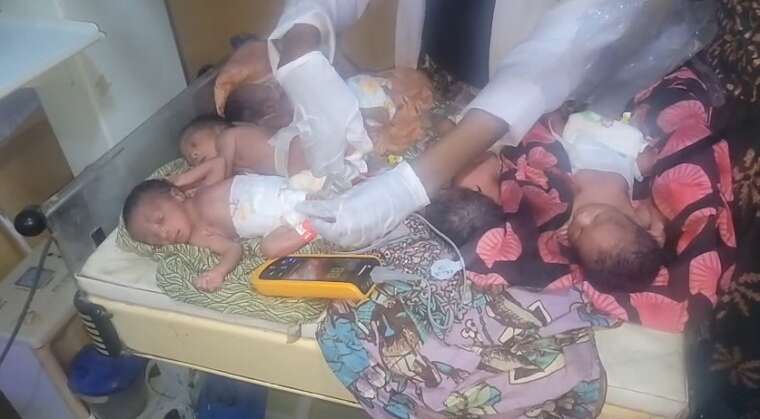
In a story that has left an entire community shaken, what began as a routine hospital visit for a pregnant mother has turned into a heartbreaking tragedy—one that now leaves a grieving father standing alone against unimaginable odds, clutching the fragile lives of 14 children.
For Salisu Nufi’u, each passing moment feels unreal, like a nightmare he cannot wake from.
His wife, Hafsatu Yusuf, had only complained of mild discomfort that day. There was no sign that their world was about to collapse. She was weeks away from her due date. They had time—or so they thought.
Then suddenly, everything changed.
What seemed minor spiraled into premature labour. Panic replaced calm. Fear replaced certainty. And within hours, the ordinary turned catastrophic.
As Nufi’u rushed to the hospital, his mind clung to what doctors had told them for months: they were expecting triplets. He had even stopped along the way to buy supplies – tiny clothes and essentials – for three babies.
Three.
That number would soon feel painfully small compared to reality.
While running errands for doctors – scrambling to get medications and blood – his phone rang.
His wife had delivered three babies.
Then came the words that made his heart stutter.
Two more were coming.
“I thought it was a mistake,” he would later say, still struggling to process it. “How could that be? We were told three.”
But there was no mistake.
When he returned, the truth stood before him in five fragile cries – three boys and two girls. Quintuplets. A miracle so rare it should have been a moment of overwhelming joy.
And for a fleeting second, it was.
Mother and babies were alive.
Hope flickered.
A Mother’s Final Premonition
Not long after the delivery, Hafsatu spoke.
She was conscious. Calm. But there was something in her voice – something that would haunt her husband forever.
“She told me she might not survive,” Nufi’u recalled, his voice breaking under the weight of memory. “She asked me to take care of the children… to make sure they go to school.”
He brushed it aside. He had to.
This was the woman who had just given him five children. She had to live. She had to.
But she repeated it.
Quietly.
Firmly.
As if she already knew.
Then came the bleeding.
At first, it seemed manageable. Then it wasn’t.
Doctors rushed in. Nurses moved with urgency. Blood was brought in. Transfusions began. The room filled with controlled chaos – voices, footsteps, silent prayers.
“They did everything they could,” Nufi’u said. “I saw them fighting for her.”
But the bleeding would not stop.
Hour after agonizing hour passed, each one stretching hope thinner, turning it fragile, brittle.
And then –
It broke.
At around 1 a.m., the call came.
Nufi’u didn’t need to hear the words to understand them. Something deep inside him already knew.
Still, he rushed to the hospital, his heart pounding, his mind begging for a different ending.
There wasn’t one.
“They told me she was gone,” he said quietly. “That moment… destroyed me.”
Inside the hospital, the woman who had just brought five lives into the world lay still.
Her voice – her final plea – became all that remained.
Before that night, they were already a large family. Ten children, though one had been lost in the past. Now, with the quintuplets, the number has risen to 14.
Fourteen.
Newborns who need constant care. Children who need food, schooling, love. A home that has suddenly lost its mother.
And at the center of it all – a man who drives a tricycle for a living, now carrying a burden that would break most.
“I work every day just to feed them,” he said. “Now… I don’t know how I will do this.”
His fears are immediate and relentless: food, healthcare, survival.
But beyond that lies something even heavier – his promise.
In the quiet moments, when exhaustion takes over and grief presses in, one thing refuses to fade:
Her voice.
Her final wish.
To care for the children.
To educate them.
To give them a future.
“I hear her every time I close my eyes,” Nufi’u said.
Now, he is asking for help—not for comfort, not for luxury, but for survival.
“I cannot do this alone,” he admitted. “I am begging… for these children.”
His plea stretches beyond his home – to authorities, to organisations, to strangers who might hear his story and feel its weight.
Because somewhere in Kano, five newborns have just entered the world without a mother.
Nine others are learning what loss feels like too soon.
And one father is standing at the edge of grief and responsibility, trying to be strong enough for all of them.
“I just pray,” he said, “that God gives me the strength to keep my promise.”
