
By Yemi Oyeyemi
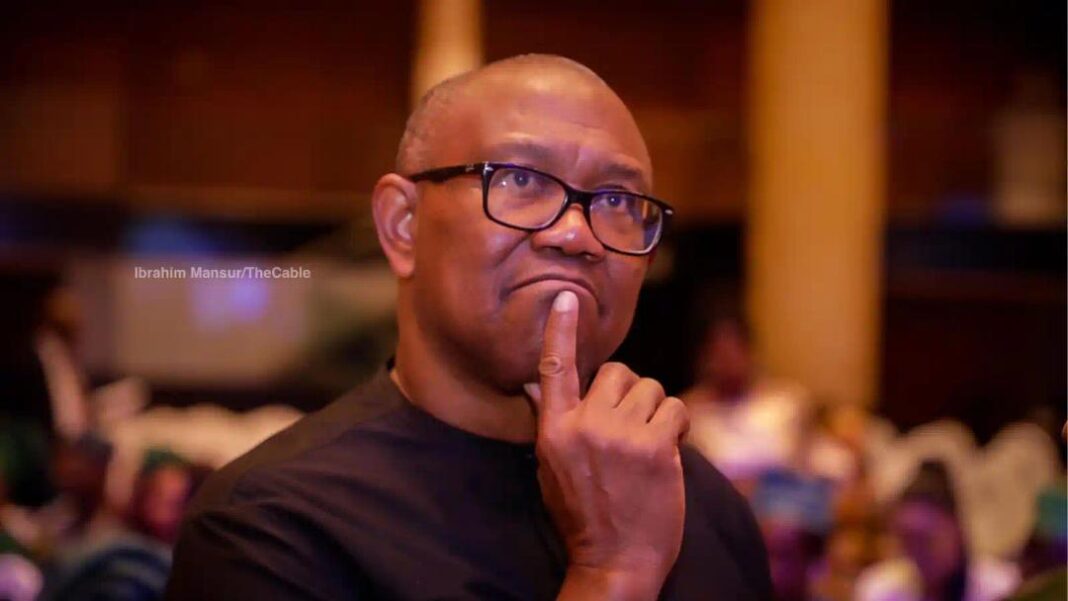
The fresh wave of controversy ignited following remarks by former President of the Court of Appeal, Isa Ayo Salami, has sent political pundits wondering what political game is in the offing.
Salami stated that Peter Obi ought not to have been allowed to contest the 2023 presidential election under the Labour Party, amid suspicions that a concerted effort is on to stop the African Democratic Congress chieftain from being fielded in 2027.
The respected jurist made the remarks while speaking to journalists after receiving the 2025 Human Rights Defender Award at the 20th anniversary of the Wole Soyinka Centre for Investigative Journalism.
Salami argued that Obi’s candidacy raised constitutional concerns, noting that the Labour Party had already submitted its membership register to the Independent National Electoral Commission before Obi defected from the PDP.
“How did he become a candidate if he doesn’t belong to the Labour Party?” Salami queried, stressing that Nigeria’s constitution does not recognize independent candidacy.
He also linked the issue to concerns about judicial competence and appointments, suggesting that systemic weaknesses in the judiciary have led to controversial rulings being upheld.
Nevertheless, Obi remains politically active despite controversy
Despite ongoing debates about his 2023 eligibility, Peter Obi has remained a central figure in opposition politics ahead of the 2027 elections.
He has defected to the African Democratic Congress (ADC), a move that has triggered fresh political realignments and tensions within the opposition.
Obi continues to publicly criticise government policies, particularly on taxation and economic management, arguing that reforms are worsening poverty.
He has also been spotted with another opposition candidate, Rabiu Musa Kwankwaso, a former presidential candidate of the New Nigeria Peoples Party (NNPP) in 2023, who watched as the only state, Kano, his party controlled slip into the hands of the All Progressives Congress (APC) when the governor, Abba Yusuf, switched party.
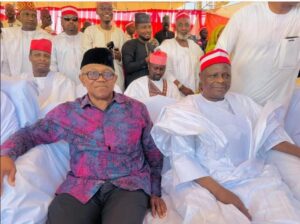
There are talks of a Peter Obi/Kwankwaso presidential candidacy following the grand reception granted Obi insists Kano by the Kwankwasiya Movement.
However, there are those who do not trust Kwankwaso, who is known to have met with Tinubu more than once.
One of such persons public commentator, Polycarp Gbaja. He wrote on social media: “I have serious doubts as to the sincerity of Kwankwaso. I will not be surprised if he is the Tinubu next strategic joker, where an asummed 2nd-In-Command, is merely a plant to pull the rug of the feet of the opposition/enemy at a critical moment for collapse. Typical script since NPN days of the 80s. Moles that will lead viable, powerful ‘factions’ that spell gameover at irreversible moments, as has happened to PDP and LP.
“Kano remains the quintessential optics of Nigeria politics, where poverty & religion have been fully weaponized & controlled for election purposes.”
The controversy around Obi’s candidacy is now part of a larger political battle:
• Former presidential aide Reno Omokri has repeatedly criticised Obi, accusing him of misinformation and political opportunism.
• Omokri also alleged Obi is “desperate” for power, reflecting how personal and intense political rhetoric has become ahead of 2027.
These exchanges show that legal questions raised by Salami are now intertwined with partisan narratives and campaign positioning.
Salami’s comments have reignited a longstanding constitutional debate in Nigeria:
• Frequent last-minute defections by politicians remain common practice.
• Critics argue that enforcement of party membership rules is inconsistent.
• Supporters of Obi maintain that courts already settled the matter by allowing his candidacy.
This reflects a deeper issue: whether Nigeria’s electoral system prioritizes legal consistency or political pragmatism.
Public sentiment: divided and highly polarised
Online and civic discourse shows sharp divisions:
• Some Nigerians agree with Salami, seeing Obi’s candidacy as legally questionable.
• Others view the criticism as selective enforcement, arguing that similar cases across parties were ignored.
• Among supporters, Obi is still seen as a credible reform candidate, while critics question both his record and political alliances.
Emerging Opinion Trends
• Legal purists: argue Salami’s position exposes flaws in electoral compliance.
• Opposition supporters: see the remarks as retrospective and politically motivated.
• Neutral analysts: believe the issue highlights the need for clearer electoral reforms, especially on party membership timelines and candidate eligibility.
Justice Salami’s comments have revived a contentious issue from the 2023 elections, but the debate has now evolved beyond legality into a larger political struggle ahead of 2027.
But is Salami flying a kite on what expect from the judiciary? Time will tell.
With Peter Obi still active and repositioning politically, the controversy is unlikely to fade soon. Instead, it underscores deeper concerns about judicial consistency, electoral integrity, and Nigeria’s evolving opposition landscape.
