
In the rugged foothills of Ngoshe, the battle has already been fought – but its echoes linger in ash, silence and fear.
What began as a sudden attack by insurgents earlier this month quickly turned into a brutal face-off between fighters of Boko Haram and security forces. Residents say the attackers stormed the town at dusk, overwhelming local defenses, torching homes and scattering thousands into the surrounding hills and nearby communities.
By the time troops regrouped and counterattacked, Ngoshe had been ravaged.
A Night of Fire
Accounts from officials and humanitarian reports paint a grim picture: civilians killed, others abducted, and entire families displaced. More than 100 people were reported missing in the immediate aftermath, while thousands—mostly women and children—fled toward Pulka for safety.
Some estimates suggest the magnitude of the raid was even larger, with hundreds abducted during the attack – an indication of the scale and coordination of the insurgents’ operations.
Even as air power and ground troops engaged the fleeing militants, the attack left behind casualties on both sides, including security personnel caught in intense combat and aerial operations.
The Counteroffensive
Within days, Nigerian troops moved to reclaim the town, engaging insurgents in and around the Mandara Hills – terrain long used as a stronghold by armed groups.
Military sources say the attack was eventually repelled, with dozens of insurgents killed and others forced into retreat under sustained pressure.
The return of troops marked a turning point: Ngoshe, briefly destabilized, was brought back under government control. Reinforcements have since doubled the military presence, reflecting both the town’s vulnerability and its strategic importance along the border region.
Zulum’s Visit: Between Grief and Resolve
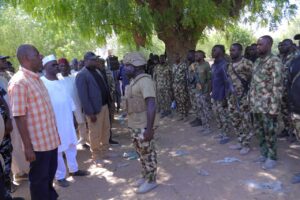
When Babagana Umara Zulum arrived days later, the scale of devastation was unmistakable.
Burnt houses stretched across neighborhoods. Public buildings lay in ruins. What remained was a town hollowed out by violence.
Describing the destruction as “devastating” and “sheer madness,” the governor’s visit doubled as both an assessment and a message: the state intends to hold its ground.
Backed by the federal government, authorities have pledged to rebuild infrastructure and restore civilian life, while boosting military operations through the Multinational Joint Task Force.
For Zulum, the stakes go beyond Ngoshe itself.
If the town falls, he warned, the impact would ripple across southern Borno – toward Gwoza, Pulka, Kirawa and beyond.
The attack on Ngoshe is not an isolated incident. It is part of a larger resurgence of insurgent activity across northeastern Nigeria in 2026, where coordinated assaults on military bases and communities have tested the limits of security forces.
Such attacks reflect a hybrid strategy: rapid raids, mass abductions and hit-and-run tactics that exploit difficult terrain and gaps in military coverage.
For civilians, the result is familiar – cycles of return, destruction, and displacement.
Holding the Line
Today, Ngoshe stands reclaimed but fragile.
Soldiers patrol its streets. Displaced families weigh whether to return. Reconstruction teams prepare to rebuild what was lost.
The insurgents have withdrawn—for now.
But in the shadow of the Mandara Hills, the possibility of another attack remains. And in this long war, holding Ngoshe is not just about territory.
It is about proving that, this time, the line will hold.
