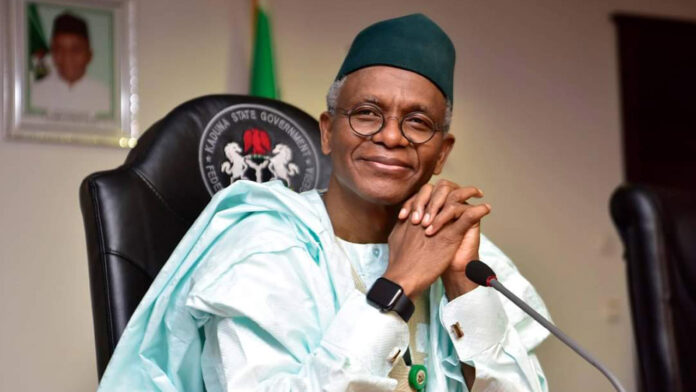
The anti-corruption landscape is set for another high-profile legal battle as the Independent Corrupt Practices and Other Related Offences Commission (ICPC) prepares to arraign former Kaduna State Governor, Nasir El-Rufai, on a raft of corruption-related charges before the Federal High Court in Kaduna.
The Commission disclosed on Monday that el Rufai will be docked alongside one Joel Adoga on March 24, 2026, in a case marked FHC/KD/73/2026. The charges, according to ICPC spokesperson John Okor Odey, include conversion and unlawful possession of public property as well as money laundering.
In a development that underscores the gravity of the allegations, the ICPC confirmed that a separate set of charges has also been filed against el-Rufai and Amadu Sule, an official linked to the Kaduna State Urban Planning and Development Authority (KASUPDA), also known as LEDA.
The second case, filed at the Kaduna State High Court under suit number KDH/KAD/ICPC/01/26, borders on allegations of abuse of office, fraud, intent to commit fraud, and conferring undue advantage. While a hearing date for this matter has not yet been fixed, both cases were instituted on March 18, 2026.
Legal observers note that pursuing parallel cases in both federal and state courts reflects the multi-layered nature of the allegations, particularly where both financial crimes and administrative abuses are involved.
The ICPC stressed that the former governor has been formally served with the charges, signaling that due process has been followed in initiating the prosecution. The agency reiterated its commitment to transparency and adherence to the rule of law.
“The Commission remains resolute in ensuring that all corruption-related cases are handled in strict compliance with legal standards,” the statement read.
Nasir el Rufai is a prominent figure on the political landscape. He served as governor of Kaduna State from 2015 to 2023 and was previously the Minister of the Federal Capital Territory under former President Olusegun Obasanjo.
Known for his reform-driven governance style, el-Rufai played a key role in urban renewal policies and civil service restructuring during his tenure. However, his administration was not without controversy, particularly over land use policies, demolitions, and public expenditure decisions.
He was also often accused of persecting political opponents.
The case comes amid renewed scrutiny of public officials by anti-graft agencies, including the ICPC and the Economic and Financial Crimes Commission (EFCC). Many say such prosecutions are critical to reinforcing accountability, though they often generate political tension, because, as in this case, prominent figures had shifted political loyalty.
Legal experts point out that money laundering charges, if proven, could carry severe penalties under the law, including forfeiture of assets and lengthy prison terms. Similarly, convictions for abuse of office and fraud could result in disqualification from holding public office.
While el-Rufai has yet to publicly respond to the charges, political observers anticipate strong reactions from both supporters and critics, given his influence within Nigeria’s political elite.
The arraignment scheduled for March 24 is expected to draw significant public and media attention, potentially setting the stage for a prolonged legal contest.
As proceedings unfold, the case is likely to serve as a litmus test for Nigeria’s anti-corruption framework, particularly in handling cases involving high-ranking former officials.
