
By Lasisi Olagunju
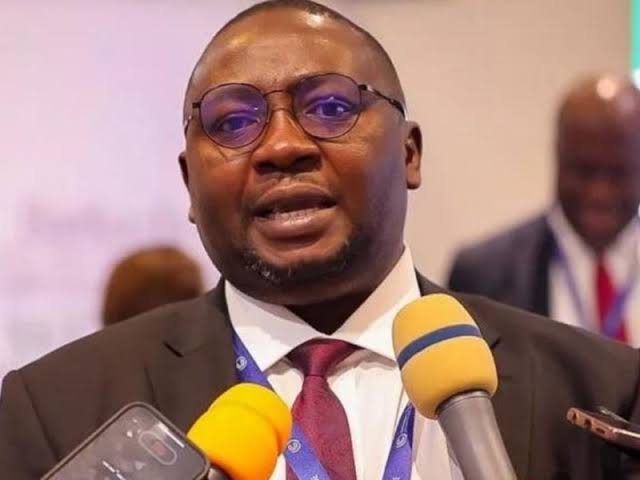
Our power minister, Adebayo Adelabu, is now mocked as the King of Darkness—Kábíyèsi Olókùnkùn. I laugh at his traducers. They are crowning the wrong monarch. The true emperor of darkness sits higher. For more than three years, the president has wandered luxuriantly through the bush of politics while abandoning the hard road of policy that might confront Nigeria’s federalist tragedy.
Kábíyèsi Olókùnkùn Birimù Birimù. Whoever coined that mouthful title deserves a GCFR in seditious satire. Political nicknames, whether in London, Paris, or Ibadan, are never innocent. They are instruments of attack in the hardtackle game of politics. Politics everywhere has its theatre, and in that theatre titles are bestowed to honour and to hurt. Nigeria’s restless political marketplace is filled with such wares of barbed sarcasm, wicked wit and withering satire which, sometimes, dress themselves in the robe of royalty.
You cannot prevent the Ifa (palm nut) from showing its palm kernel behavior (Kò sì bí a ò ti ṣe Ifá tí kò ní hù’wà ekuro). It is in the nature of politics and politicians to fly or shoot down ambitions. Adebayo Adelabu seeks to feature in next year’s governorship election in Oyo State. Sometimes one pursues a title and gets a completely different one. Shehu Shagari wanted to be senator, he became president; Ahmadu Bello wanted to be Sultan of Sokoto, he became the premier of the whole of northern Nigeria. Adelabu’s impatient ‘lovers’ in his Ibadan have made him king. They dressed him up in a regalia of scorn and crowned him Kábíyèsi Olókùnkùn of Okunkun—His Royal Majesty, the King of Darkness. They say he is in charge of national grid collapse and unending darkness. Their reasoning is simple and brutal: Ibadan, the minister’s hometown, is lit up in months of unremitting darkness under his watch. So, if the city, and indeed, the entire country sits in pitch darkness, the minister of power must be its monarch.
But the logic of power does not quite support their satire. In governance, ministers are not sovereigns; they are agents. The sovereign authority belongs to the principal who appoints them. In presidential systems, that principal is the president. In administrative theory, responsibility flows upward. Authority is at the very top. The minister executes policy; the president embodies and orders it. If Nigeria must coronate a monarch for darkness, political logic suggests that the throne cannot be occupied by the minister; it belongs to the president. He is the one holding the faulty switch of light. His head this crown of darkness fits.
In quarrelsome politics, songs easily become proverbs, and proverbs songs. To crown Adelabu the “King of Darkness” while sparing his appointor is to blame the drum for a rhythm composed by the drummer. A bad workman, the proverb says, always blames his tools. Ministers are tools; the hand that wields them writes the music.
The minister is styled Olókùnkùn Birimù Birimù I. The regnal ordinal “I” (The First), suggests that before him, history has produced no predecessor worthy of such investiture. Olókùnkùn The First, stands, therefore, as a founding ancestor to future failure, progenitor of a dynasty of darkness. But if a minister presides over a mere kingdom of darkness, the president reigns over an empire and should not be denied his own befitting imperial crown.
History is full of such ‘wicked’ coronations. In England, King John (1166–1216) earned the enduring title “John Lackland” (John without land; Jean sans Terre) because, as a younger son, “he was not expected to inherit significant lands.” The nickname stuck so firmly that it followed him into the chronicles of English history. Later, the English would also mock King Charles II as the “Merry Monarch,” because his reign “was defined by a revival of the arts, the reopening of theaters, and a famously colorful personal life involving numerous mistresses and illegitimate children.”
History offers more of such honours. England had another monarch remembered in popular lore as “Mad King George.” King George III, who ruled from 1760 to 1820, suffered bouts of severe mental illness that produced periods of rambling speech, hallucinations and erratic conduct. Those afflictions eventually gave rise to the enduring nickname “the Mad King.” He remains till this day, “the longest-lived and longest-reigning male monarch in British history.” France had its own tragic parallel centuries earlier in Charles VI, remembered bluntly as Charles le Fou—Charles the Mad.
The French were more inventive. For John I (28 May 1371 – 10 September 1419), they had him as John the Fearless (Jean sans Peur ). There was also Philip II the Bold (Philippe II le Hardi) who reigned from 17 January 1342 – 27 April 1404). Long before the revolution fulfilled the prophecy, Louis XVI was already mocked as Louis le Dernier—Louis the Last. And during the turbulence of the French Revolution, Louis-Philippe got a nickname. Louis-Philippe came to power after the barricades of the July Revolution of 1830, and because of that, he was called “king of barricades.”
Across the Atlantic, American politics produced its own gallery of biting nicknames. The wood, Hickory, has a reputation as a very strong, flexible, and shock-resistant wood. Andrew Jackson was celebrated by his supporters as “Old Hickory,” a nickname earned during the War of 1812 for his toughness and stubborn endurance. His critics, however, sharpened the image into “King Andrew I,” accusing him of ruling the young republic with monarchical arrogance.
Martin Van Buren, the 8th president of the United States (1837–1841), was mocked by opponents as “Martin Van Ruin,” a taunt born of the economic distress that defined his presidency. A century later, Richard Nixon acquired the corrosive label “Tricky Dick,” a nickname that reflected widespread suspicion of his political tactics.
Even cabinet officials have not escaped such satirical baptisms. During the Cold War, ponderous Secretary of State John Foster Dulles, who once described himself as “a cold fish” was derided by critics as “Dull, Duller, Dulles.” In the United States, as elsewhere, the nickname often becomes a political weapon sharper than argument.
In contemporary Britain, the tradition survives. Political opponents and tabloids have long tried to pin labels on the current Prime Minister, Keir Starmer. During the COVID 19 pandemic debates, Starmer, as leader of opposition, was called “Captain Hindsight” by his opponent, Boris Johnson in mockery of his criticisms which were done “with the benefit of hindsight.” At another point, Johnson again taunted him as “Sir Beer Korma” in reference to an investigation into a lockdown era allegation that Starmer had breached Covid-19 social distancing rules “while eating a takeaway meal and drinking beer at an MP’s office.”
The system is not done with Starmer. At a point, the Conservative politician, Rishi Sunak borrowed a tabloid headline and slammed it on Starmer calling him “Sir Softy,” an attempt to portray him as weak on crime. The Sun newspaper, it is said, owns the proprietary rights on that “softy” invention. The label later migrated to the parliament which snatched and ran away with it. But analysts won’t call what happened theft; they say it is proof of the feedback loop between media rhetoric and political combat.
In Nigeria’s political theatre, presidents have rarely escaped the sting of nicknames. Goodluck Jonathan was branded “the Clueless One” by the opposition All Progressives Congress, a label meant to portray his government as drifting without direction. His successor, Muhammadu Buhari, came and acquired the mocking sobriquet “Baba Go Slow,” a jab at the perceived sluggish pace of his administration. Today, Bola Ahmed Tinubu is derided in Obidient circles as “Bulaba”, one of his many campaign gaffes.
The case of Umaru Musa Yar’Adua was different and complicated. He was slow and absent. His presidency was defined by circumstance, his prolonged illness and absence from public life, leaving history to remember him less by a mocking title than by the quiet fragility of his tenure.
Now we have a minister garbed in the golden apparel of dank darkness.
Elisabeth Staab’s ‘King of Darkness’ might well look on with envy at the appropriation of its sunless title by Nigerian politics. The same reaction may be expected from ‘Kings in Darkness’, a 1962 sword-and-sorcery short story by the English writer Michael Moorcock. In that story that reads like Nigeria, two distressed adventurers who barely escape with their lives from a city of beggars, stumble into a cursed forest. The title feels oddly apt for Nigeria of today.
Back to Nigeria’s power crisis and the anger in the streets: are we condemned to spend this century groping through darkness?
We have a peacock government that prances and preens as though it were the best that will ever be. But if the unwell is left to roam the streets as he pleases, he will soon turn the neighbourhood into a warehouse of filth. We should be talking and acting. Is the mockery of the minister part of that talking? I don’t know.
I suspect the government will calm the angry by telling them that there is nothing new or unseemly in the unfurled darkness over the Nigerian skies. The price of petrol competes in space with war missiles in the Middle East. Electricity tariff here does not do that. The cost of power does not rise every day and night like the third leg of the lecherous. That should be a plus for this government, and for which it should be praised.
American writer and poet, Carl Phillips, says that restlessness might not solve any problem, but it is a force which he would not refuse. In search of clues from history, I always turn to books and scholars. David E. Nye’s ‘When the Lights Went Out: A History of Blackouts in America’ recounts how, during a major power failure in July 1977, New York City slipped into arson, looting and riots. So, as they do on earth, so they do in heaven! Hillard G. Huntington’s ‘The Historical “Roots” of U.S. Energy Price Shocks’ reminds us that energy disruptions have long shaken economies. Huntington traces “sustained energy price increases” as far back as the 1890s and shows how such shocks often precede economic decline. What my restless search found is that wrong policies (or the absence of policy altogether) have a way of switching off the light in people’s lives.
Indeed, as late as the 1970s, the United States (today’s emblem of industrial stability) was itself trapped in an energy crisis that rattled its politics and economy. Long queues at petrol stations suggested a sudden oil shock. Energy historian Robert D. Lifset, in ‘A New Understanding of the American Energy Crisis of the 1970s’, argues that the crisis ran deeper. He said what looked like an oil shortage was in fact the convergence of structural distortions across oil, natural gas and electricity—rising consumption, policy missteps and market imbalances that had accumulated for years until external shocks exposed them.
Nigeria’s present electricity emergency fits that pattern almost perfectly. The threat by gas suppliers to halt supply to power plants over mounting debts is not the disease but merely a symptom; it is the evidence of a distorted power market, a broken payment chain, and a dangerously centralised electricity system where a single financial blockage plunges an entire nation into darkness.
My point, therefore, is that Nigerians protesting blackouts are reacting to symptoms that manifest as outages. They should instead be seen, and heard, rebelling against a federal system designed to malfunction. Perhaps if we studied how the United States confronted and eventually resolved its energy crisis some fifty years ago, we might learn something useful. But such learning presumes a federation that works. Nigeria stopped working soon after independence. It stopped thinking right a long time ago. America’s response to its own crisis was anchored in a federal structure that allows its states and markets room to innovate and correct failure. Nigeria, by contrast, remains trapped in a dubious federal arrangement whose excessive centralisation breeds the very pests (and blood-sucking bedbugs) of crises it endlessly pretends to fight.
In any crisis, clarity of vision and sincerity in leadership matter. The president promised while asking for votes the last time: “Whichever way, by all means necessary, you will have electricity, and you will not pay for estimated bill anymore. A promise made will be a promise kept.
“If I don’t keep the promise and I come for a second time, don’t vote for me. Unless I give you adequate reasons why I couldn’t deliver.”
He launched his reelection campaign the very day he was sworn in. Has he given any reason why he failed to fulfill his electricity promise? None. The hungry man who once begged for èbà on credit has now married his creditor and is threatening to impregnate him with heavier debts.
A president who campaigned with the promise of light now rules with the torch of darkness. And everyone seems to have surrendered to him, even while sleeping and waking in utter hopelessness. It is tough for everyone; businesses are sweating blood under the weight of diesel and its cost which swells per minute like garri Ijebu. “Life here is tough. One has to be a devil to survive.” Donne, the principal character in Wilson Harris’s ‘Palace of the Peacock’, might well have been speaking of today’s Nigeria when he uttered that line.
“Olókùnkùn Birimù Birimù” has the cadence of poetic excellence. Political nicknames compress criticism into memorable phrases that travel faster than argument. Yet, satire also demands intellectual consistency. If Adebayo Adelabu is to be enthroned as Kábíyèsi over the kingdom of darkness, the crown cannot sit comfortably on his head. A chief cannot be king. The minister is not the head. In any system of delegated authority, the crown of responsibility climbs the ladder to the top.
So, enough of straw-stuffed dummies and effigies that are easily knocked down and destroyed. Throw the dart where the problem lies. If darkness reigns, the court must decide who truly wears the crown. After all, in the old, and even in contemporary Yoruba courts, no one addresses a courtier as king. Haughty Basorun Gaa was once greeted as “Kábíyèsi” by some frightened townspeople; he rebuked them: “K’áraóle là ń kí Ọsòrun.” (It is “be well” that we say to the Basorun.) The president professes this failure and must therefore receive the commensurate commendation for it. My muse gave me a proverb: “àṣẹ ọba ni ìlú fi ń ṣàye” (it is the king’s authority that sets the town in motion—or in demotion). The president, who has chosen politics as his only core course, is the true sovereign of this empire of darkness: I call him Ààrẹ Olókùnkùn.
● Published in the Nigerian Tribune of 16 March, 2026
