
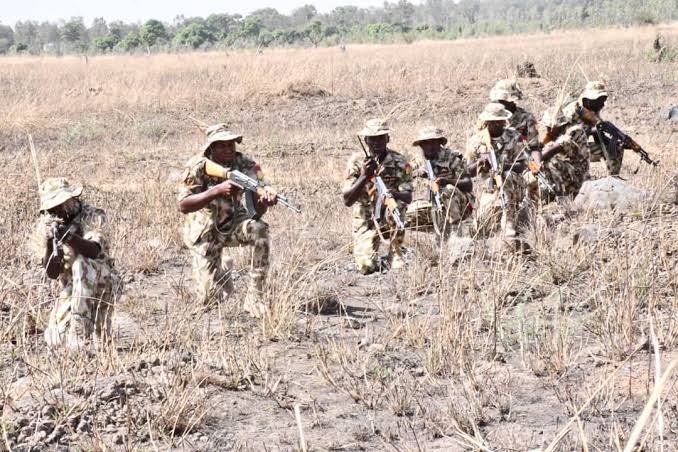
In the dusty, conflict-scarred plains of northeastern Nigeria, the war against insurgency is once again exacting a heavy toll on the country’s military leadership. Within just three months, at least seven commanding officers and one brigadier general have reportedly been killed in the line of duty, many of them while defending remote forward operating bases scattered across Borno State.
The deaths — occurring amid a wave of coordinated insurgent assaults — underscore the continuing resilience of extremist groups such as Boko Haram and the Islamic State West Africa Province, nearly seventeen years after the insurgency began.
Despite sustained military campaigns, the battlefields of Borno — from the dense Sambisa Forest to the islands of the Lake Chad Basin — remain volatile.
A War That Keeps Claiming Commanders
The latest loss came in the early hours of March 9, when insurgents stormed a military base in Kukawa Local Government Area, launching a coordinated assault shortly after midnight.
According to security sources, fighters attacked the camp from several directions, overwhelming troops after intense gun battles.
The commanding officer of the base, Lt-Col Umar Faruq, was killed alongside several soldiers as militants set military vehicles ablaze and seized ammunition.
The attack is part of a wider surge in violence across the region. Military authorities later confirmed that insurgents had simultaneously targeted multiple locations — including Dalwa, Goniri, Kukawa and Mainok — in a series of coordinated operations between 10 p.m. and 3 a.m.
Despite fierce resistance and reinforcement from the air component of Operation Hadin Kai, the assaults resulted in casualties among the troops.
Three Commanders in One Week
The Kukawa tragedy followed two other deadly incidents involving commanding officers within a week.
On March 6, Lt-Col S.I. Iliyasu, commanding officer of the 222 Battalion in Konduga, was reportedly killed when insurgents attacked troops stationed near the town.
Days earlier, on March 1, Major Umar Ibrahim Mairiga, commander of a forward operating base in Mayenti, Bama Local Government Area, died while resisting an insurgent assault.
Sources said Mairiga fought fiercely before being overpowered after several soldiers retreated into the surrounding bush.
“He gave them a tough fight,” a security source said. “Several insurgents were killed before he was eventually overwhelmed.”
The officer had reportedly been deployed to the base only months earlier following a special promotion.
A Pattern of Targeted Attacks
The killings are part of a troubling pattern.
Investigations show that most of the fallen commanders died either during direct assaults on military bases or in ambushes during clearance operations — tactics increasingly used by insurgents across the region.
Earlier incidents include:
January 28: A commanding officer and several soldiers killed in an ambush near Damasak.
October 2025: The Nigerian Army confirmed the death of Lt-Col Aliyu Saidu Paiko, commander of the 202 Battalion, during an encounter with insurgents in Bama.
The insurgents’ ability to mount complex attacks on fortified bases has raised concerns among security analysts and residents alike.
In some cases, militants reportedly arrive in large numbers, attacking from multiple directions and exploiting the darkness of night to breach defensive perimeters.
Civilians Caught in the Crossfire
While the military absorbs heavy losses, civilians continue to bear the brunt of the conflict.
In Ngoshe, Gwoza Local Government Area, a coordinated insurgent attack on a military base reportedly left fourteen soldiers dead, with hundreds of residents fleeing toward the nearby town of Pulka. More than 100 civilians were reportedly abducted, while homes and infrastructure were destroyed.
Elsewhere, insurgents recently attacked Dalwa, a community just 20 kilometres from Maiduguri, forcing residents to flee only months after the Borno State government had resettled them.
The region has suffered catastrophic human losses since the insurgency began in 2009, with more than 35,000 people killed and over two million displaced across northeastern Nigeria and neighbouring countries.
A Long War With No Easy End
Security experts warn that the deaths of senior officers are particularly alarming because of the years of training and experience required to produce military commanders.
Military Pressure Continues
Despite the recent losses, the Nigerian military insists it is maintaining pressure on insurgent groups.
Operations have intensified across several key battlegrounds — including Sambisa Forest, the Mandara Mountains and the “Timbuktu Triangle,” a vast insurgent hideout stretching toward Lake Chad.
Recent operations in Konduga reportedly led to the killing of eight Boko Haram and ISWAP fighters, with weapons and ammunition recovered by troops and members of the Civilian Joint Task Force.
Military authorities say follow-up operations and aerial surveillance are ongoing to track wounded militants and dismantle remaining camps.
A War Still Far From Over
Nearly two decades after the insurgency began, northeastern Nigeria remains one of Africa’s most persistent conflict zones.
The extremist groups themselves are fragmented — sometimes fighting each other for control of territory around Lake Chad — yet they remain capable of launching devastating attacks.
For soldiers stationed in the region’s remote bases, the danger is constant.
And for the families of the officers killed in recent months, the war has already taken its highest price.
As Nigeria presses on with its counter-insurgency campaign, the names of the fallen commanders serve as a stark reminder of the human cost of a conflict that refuses to fade.
● With reports by Daily Trust
