
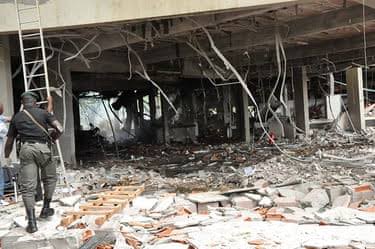
A Federal High Court in Abuja has granted an application by the Department of State Services (DSS) for an accelerated hearing in the trial of five men accused of carrying out the August 26, 2011 bombing of the United Nations building in Abuja.
Justice Emeka Nwite approved the request on Monday following an application by prosecuting counsel Alex Izinyon (SAN). Izinyon invoked the 2022 Practice Direction on the prosecution of terrorism and related offences issued by the Chief Judge of the Federal High Court, Justice John Tsoho.
The prosecution noted that the case has been pending for nearly 10 years and urged the court to allow day-to-day proceedings where possible to ensure its speedy determination. Defence counsel did not oppose the application, and the court granted it.
The accused are Al-Barnawi, also known as Kafuri, Naziru, Alhaji Yahaya, Mallam Dauda and Alhaji Tanimu; Mohammed Bashir Saleh; Umar Mohammed Bello (also known as Datti and Mohammed Salisu); and Yakubu Nuhu (also known as Bello Maishayi).
During proceedings, a senior DSS operative testified in a trial-within-trial to determine whether the defendants made their statements voluntarily. The witness, identified as PW3, is a computer forensic expert in the DSS Technical Department.
Under cross-examination by Bala Dakum, counsel to the second defendant, the witness said he could not recall the exact date a video recording of one interview session, admitted as Exhibit C, was made. He stated, however, that the interviews with the five defendants took place between 2016 and 2017.
PW3 rejected claims that the recording of the second defendant’s statement contained gaps. He also maintained that the DSS uses portable forensic recording devices that comply with the Evidence Act and international standards.
Responding to allegations that cautionary words were not administered before the statement was taken, the witness said his role was limited to recording proceedings and not conducting interviews. He added that from the video evidence, the second defendant was cautioned, informed of his rights, and given the option to decline or seek legal counsel before voluntarily proceeding.
The witness further stated that all official interactions between interviewers and defendants were recorded. He explained that only the defendants’ faces are typically shown in recordings to protect the security of DSS interviewers, although parts of interviewers may appear incidentally during exchanges of documents or materials.
He emphasized that the recording equipment is tamper-proof and designed to prevent editing. According to him, the device records simultaneously onto two identical DVDs in real time and automatically closes and digitally signs files if paused, making further alterations impossible.
The court adjourned the matter until March 4 for continuation of hearing.
