
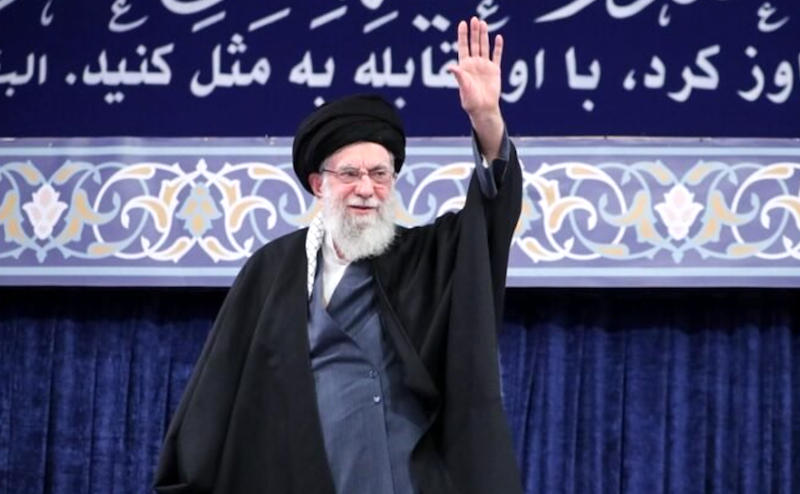
Iran has been rocked to its core.
In a stunning announcement that sent shockwaves across the Middle East, Iranian state television declared that Supreme Leader Ali Khamenei was killed in a ferocious wave of U.S.–Israeli bombardment.
No images. No immediate proof. Just a blunt confirmation from the regime’s own mouthpiece: the Islamic Republic’s most powerful figure is dead.
According to state media, Khamenei was killed at his office early Saturday during what officials described as “wide-ranging strikes” by the United States and Israel. Within hours, Tehran announced 40 days of public mourning — a ritual reserved for the most sacred figures in the Islamic Republic.
Iran’s powerful Supreme National Security Council thundered that his death would ignite a “great uprising against the tyrants of the world.”
The feared Islamic Revolutionary Guard Corps (IRGC) vowed “decisive revenge,” warning that “the hand of revenge of the Iranian people will not let go of the killers of the Imam.”
In fiery rhetoric, the Guards described Khamenei’s death as martyrdom — not defeat. “His path will not stop after his martyrdom,” the statement declared, urging citizens to flood national defense gatherings in a show of unity against “terrorists” and “enemies of the nation.”
Behind the thunderous words lies a sobering reality: the man who has ruled Iran with an iron grip since 1989 is gone.
Trump’s Blunt Declaration
Hours before Tehran’s formal confirmation, U.S. President Donald Trump took to his social media platform, Truth Social, with a characteristically explosive message:
“Khamenei, one of the most evil people in History, is dead.”
Speaking later to CBS News, Trump hinted that “there are some good candidates” to lead Iran but declined to elaborate.
Israeli officials said Saturday’s coordinated assault targeted key leadership sites, killing senior figures including Iran’s defense minister and the head of the IRGC.
A Trio Takes the Helm
With the Supreme Leader gone, Iran’s constitution has kicked into emergency mode.
State media announced that a three-man council will steer the country through the transition: President Masoud Pezeshkian, judiciary chief Gholamhossein Mohseni Ejei, and a senior cleric from the powerful Guardian Council.
Their mandate? Hold the line until the Assembly of Experts — an 88-member body of clerics — selects a new Supreme Leader. Iranian law demands the appointment happen as swiftly as possible.
But who could fill Khamenei’s shoes? For now, Tehran is silent.
Exiled Crown Prince Makes His Move
Into the vacuum stepped an old name with royal echoes: Reza Pahlavi, son of Iran’s last shah.
Writing in the The Washington Post, Pahlavi declared himself ready to lead a transitional government.
“Many Iranians, often even after facing bullets, have called on me to lead this transition,” he wrote. “I have answered their call.”
He promised a new constitution, a national referendum, and free elections under international supervision — vowing there would be “no chaos” and “no power vacuum.”
Pahlavi’s father, Mohammad Reza Shah Pahlavi, ruled from 1941 until he was toppled in the 1979 Islamic Revolution. The younger Pahlavi has lived in U.S. exile for decades, long a symbol of monarchist nostalgia and fierce opposition to the Islamic Republic.
Now, with Tehran’s strongman gone, he is openly positioning himself as the face of a post-Khamenei Iran.
The killing of Ali Khamenei marks the most significant development yet in the shadow war between Iran, Israel and the United States — and potentially the most destabilizing moment in the Islamic Republic’s 47-year history.
Tehran is promising revenge. Washington is projecting confidence. Israel is silent but watchful.
And across Iran, a stunned nation begins 40 days of mourning — even as the world braces for what comes next.
