
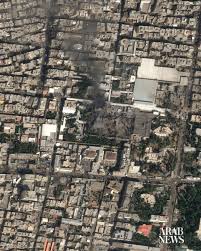
The fragile equilibrium of the Gulf was violently upended on Saturday as Iranian missiles streaked across cloudless desert skies, striking US-linked military facilities and sending residents from Manama to Abu Dhabi scrambling for cover in scenes few believed possible in the oil-rich monarchies.
Explosions reverberated through neighborhoods long synonymous with luxury, security and geopolitical insulation. In Dubai, home to the world’s tallest building, the Burj Khalifa, residents craned their necks to watch missiles arc overhead before distant booms rattled high-rise windows. In Doha, a projectile plunged into a residential district, erupting in a fireball that sent dozens fleeing in panic.
The primary targets appeared to be US military installations, including facilities housing the US Navy’s Fifth Fleet in Bahrain’s Juffair district and American assets near Abu Dhabi. Smoke was seen rising from affected sites as emergency services sealed off surrounding roads.
For a region that has invested billions in cultivating an image of predictability and safety, the psychological toll was immediate and profound.
“We Didn’t Know What to Do”
“When we heard the sounds, we cried out of fear,” said Jana Hassan, a 15-year-old visiting a friend near the US naval compound in Manama. “We didn’t know what to do… I will never forget the sound of those loud blasts.”
Residents described confusion in the first minutes after impact. In Dubai, one expatriate recalled “a rumble and then a bang,” followed by sirens. An American resident of Doha said she heard two blasts while driving home, and later “several more,” as glass shook in her apartment.
She has lived in Qatar for two decades. “I’m furious,” she said, speaking on condition of anonymity. “My teenage sons are asking me if we will have to go back home.”
Across the Gulf, where expatriates often outnumber citizens, the attacks pierced a deeply held assumption: that while wars might rage in Yemen, Syria or Gaza, the financial capitals of the Arabian Peninsula would remain shielded.
The strikes come at a moment of delicate diplomacy in the Gulf. For years, the monarchies have sought to balance ironclad security partnerships with the United States against cautious engagement with Tehran.
In 2023, Saudi Arabia restored diplomatic ties with Iran after a seven-year rupture, a rapprochement widely viewed as an attempt to reduce regional volatility. The United Arab Emirates and Qatar have similarly maintained pragmatic channels with Tehran, even as they host significant US military assets.
Qatar’s Al Udeid Air Base — previously targeted in a telegraphed Iranian strike last June — remains one of Washington’s most critical regional hubs. In September last year, Israel struck what it described as a Hamas meeting in Doha, underscoring how Gulf capitals have increasingly found themselves entangled in the wider Middle East conflict.
Until now, however, such incidents were rare and often carefully calibrated to avoid mass disruption.
Saturday’s barrage was different in scale and symbolism. Missiles visible over skylines synonymous with commerce and tourism sent a message that geography alone would no longer guarantee immunity.
Trauma Rekindled
In Riyadh, residents reported hearing loud detonations, though details of damage remained unclear. A 31-year-old Lebanese expatriate and mother of two said the blasts reopened old wounds.
“As a Lebanese, I am traumatised,” she said. “We came to the Gulf because it’s known to be safer than Lebanon. Now I don’t know what to do or how to think, really.”
Another resident, a Jordanian father, described stepping outside with his young son when the sky thundered. “It was honestly very scary and very loud. People around us were looking up, trying to understand what was happening. It’s not something you expect in Riyadh.”
The UAE has not faced such a shock since missile and drone attacks by Yemen’s Houthi rebels in 2022, which targeted Abu Dhabi and prompted a swift tightening of air defenses. Saudi Arabia, once the frequent target of cross-border strikes from Yemen, has seen relative quiet in recent years as diplomatic efforts cooled that front.
Markets and Mobility
Airlines rerouted flights. Some schools announced temporary closures. Oil markets, already sensitive to regional risk, reacted nervously in early trading.
Beyond the immediate military calculus, analysts say the deeper impact may be reputational. The Gulf’s brand — safe haven, logistics hub, tourist magnet — rests on predictability. The gleaming towers of Dubai and the cultural institutions of Abu Dhabi symbolize a deliberate pivot away from the turmoil that has engulfed other parts of the Middle East.
If missile exchanges become normalized, foreign investment and long-term residency decisions could shift. Multinational firms headquartered in the Gulf for regional operations may reassess contingency plans. Expatriate families, who form the backbone of sectors from finance to education, are weighing options.
A Region on Edge
Officials across the Gulf have not publicly detailed the extent of damage or casualties, emphasizing instead the effectiveness of air defense systems and coordination with allies. Washington has condemned the strikes, and diplomatic channels are reportedly active.
Yet the images of missiles over placid coastlines may linger longer than the smoke.
For decades, Gulf rulers have sought to insulate their societies from the region’s upheavals through wealth, diplomacy and security alliances. Saturday’s events suggest that even the most carefully constructed buffer can be pierced.
As one Doha resident put it, watching her windows tremble: “You always think it’s happening somewhere else. Not here.”
