
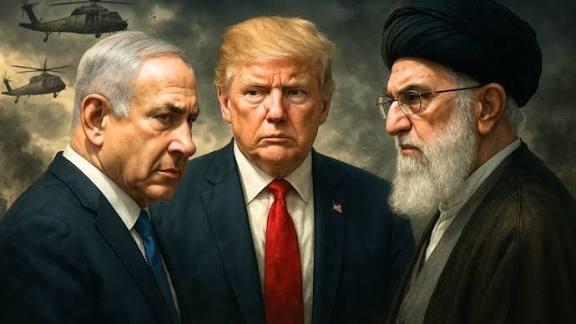
In a stunning escalation of Middle East hostilities, Israeli and U.S. officials are publicly suggesting that Ayatollah Ali Khamenei, the long-time Supreme Leader of Iran, may have been killed in a massive joint military strike earlier today — though Tehran continues to deny the claims.
Israeli Prime Minister Benjamin Netanyahu said Saturday evening that there are “many signs” the 86-year-old leader is “no longer alive” following wide-ranging strikes on Iranian leadership and command centres. In a televised address, he declared that Iran’s compound in Tehran was destroyed and that senior Revolutionary Guard commanders and nuclear officials were killed in the assault.
“No one is immune,” Netanyahu said, calling the attack a decisive blow to a regime he accused of spreading terror for decades. He also urged the Iranian people to “flood the streets and finish the job,” describing the strikes as an opening for internal change.
In Washington, Donald Trump told NBC News he believes reports that Khamenei has been killed are “a correct story,” saying U.S. intelligence assessments indicate that “most” of Iran’s senior leadership was eliminated in the operation. Trump stopped short of providing independent confirmation, noting only that “we feel that is a correct story.”
The strikes – part of a campaign dubbed Operation Epic Fury – were launched early Saturday and targeted air defences, missile sites, command hubs, and high-level leadership locations across Iran. Reports indicate hundreds of casualties and extensive damage to strategic infrastructure.
However, Iranian authorities have rejected the claims about their leader’s death. State media outlets cited officials close to Khamenei who insist he remains “firmly and decisively commanding the field,” and the country’s Foreign Minister told NBC News that, “as far as I know,” both Khamenei and President Masoud Pezeshkian are alive.
The unprecedented nature of the attack and suggestions of Khamenei’s death have ignited a wave of reactions around the world:
• Iran has launched retaliatory strikes against U.S. bases and Israeli targets in the region, marking a broader expansion of hostilities.
• Oil markets have surged on fears of instability in the Gulf as the Strait of Hormuz teeters on disruption. Analysts warn of severe economic shock waves if conflict spreads.
• United Nations officials have called an emergency session of the Security Council as diplomatic efforts to avert full-scale war intensify.
• Several world capitals, including European and Arab states, have condemned the escalation and urged all parties to de-escalate immediately.
If the reports of Khamenei’s death are verified — a development not yet independently confirmed — it would plunge Iran into a profound succession crisis. The 86-year-old cleric had been the country’s supreme authority for more than three decades, shaping both domestic politics and foreign policy.
Legal and constitutional mechanisms for replacing a supreme leader exist, but without an obvious successor and amid escalating conflict, analysts say Iran faces a period of instability that could redefine its future.
Tehran’s clerical establishment, and especially the powerful Islamic Revolutionary Guard Corps, may now emerge as key players in determining the nation’s direction.
Despite the claims from Israeli and U.S. leaders, independent verification remains absent. Tehran has not released substantive confirmation or imagery regarding Khamenei’s status. Satellite and battlefield intelligence are being assessed by global agencies, but conclusions may take days or weeks to emerge, if they come at all.
For now, world capitals are watching anxiously as one of the most consequential military confrontations of the 21st century continues to unfold.
This story is developing and will be updated as verified information becomes available.
