
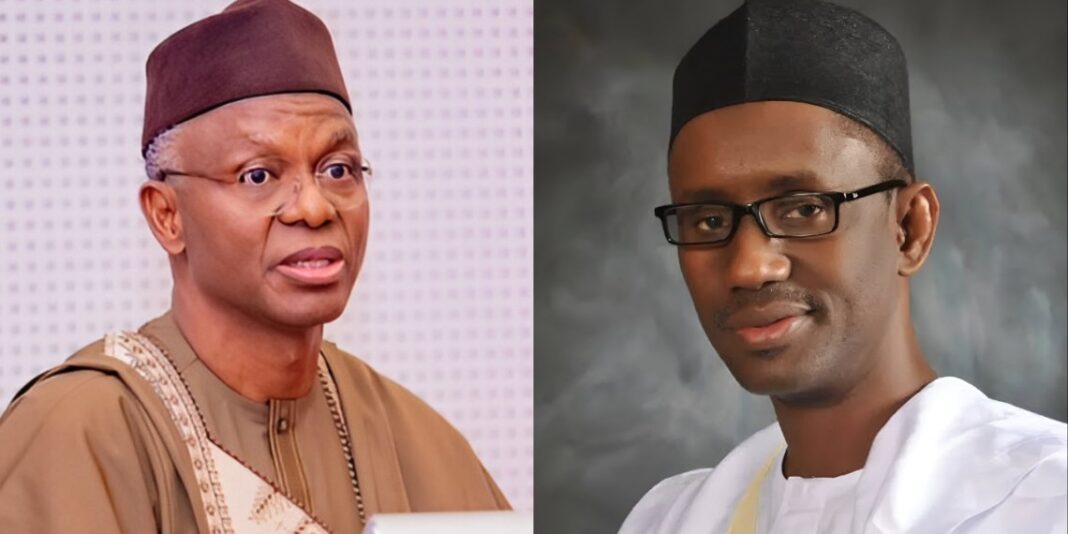
Former Kaduna State Governor, Nasir Ahmad El-Rufai, has mounted a legal challenge against a suit filed by the country’s internal intelligence agency over alleged wiretapping, asking the Federal High Court in Abuja to dismiss the case on constitutional and procedural grounds.
He is also for a court order awarding him ₦2 billion (two billion naira) in costs/damages against the DSS for what his lawyers describe as “abuse and misuse of the court process, and the unconstitutional use of the criminal justice system to harass and embarrass him.”
The suit, instituted by the Department of State Services (DSS), accuses the former Kaduna State governor of involvement in unlawful interception of communications – an allegation that has added a new twist to the already tense political climate.
In a preliminary objection filed by his legal team, El-Rufai is challenging what he describes as the “competence and constitutionality” of the charge. Central to his argument is the claim that the DSS, as named in the suit, is not a legal entity recognized under the law.
His lawyers contend that the agency formally established under the National Security Agencies Act is the State Security Service (SSS), not the DSS. According to the defence, any charge brought in the name of the DSS is therefore “incompetent and void.”
Legal analysts note that while the terms DSS and SSS are often used interchangeably in public discourse, the technical distinction could become pivotal in determining whether the court has jurisdiction to entertain the matter.
Beyond the naming issue, El-Rufai’s counsel is also contesting the agency’s authority to prosecute criminal matters. The defence argues that even if properly constituted, the DSS lacks statutory prosecutorial powers to independently initiate criminal proceedings without recourse to the office of the Attorney-General of the Federation.
Under Nigeria’s constitutional framework, prosecutorial authority in federal matters typically rests with the Attorney-General, though security agencies may investigate and collaborate in prosecutions.
The legal team further insists that the charge fails to disclose any offence recognized under Nigerian law and is therefore “incurably defective.” They also argue that the particulars of the alleged offences were not sufficiently provided, thereby violating El-Rufai’s constitutional right to fair hearing and protection against self-incrimination.
El-Rufai, a prominent figure in Nigeria’s political landscape and a former minister of the Federal Capital Territory, has remained an influential voice in national affairs since leaving office in 2023. Observers say the case could carry political undertones, though neither the DSS nor the former governor has publicly described it as such.
The DSS, the primary domestic intelligence agency, has broad powers to investigate threats to internal security, including cybercrime and unlawful surveillance activities. However, questions around its prosecutorial reach have surfaced in past legal disputes.
The Federal High Court is expected to fix a date to hear arguments on the preliminary objection. The outcome could prove decisive: if the objection succeeds, the case may be struck out before trial. If dismissed, the matter would proceed to substantive hearing on the alleged wiretapping charge.
For now, the courtroom battle sets the stage for what could become a significant legal test of both procedural technicalities and the limits of security agency powers under Nigerian law.
