
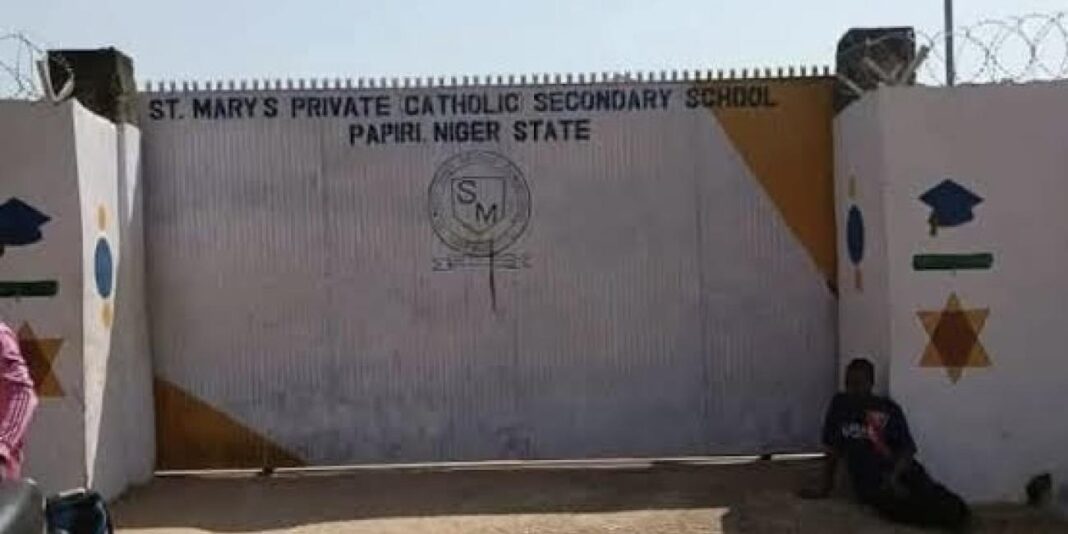
An investigation by Agence France-Presse (AFP) has alleged that the federal government secretly paid a multimillion-dollar ransom to secure the release of up to 230 pupils and staff kidnapped from St. Mary’s Secondary and Primary School in Papiri, Niger State.
But the Federal Government on Tuesday dismissed the reports.
Minister of Information, Mohammed Idris, while describing the claims of ransom payment as false and baseless, stated that rather than the report being factual, it relied on unnamed and shadowy sources.
According to AFP, the ransom was transported by helicopter to Gwoza in Borno State — a known Boko Haram stronghold near the Cameroon border. Three sources told the agency the funds were handed to a commander identified as Ali Ngulde. Because of poor telecommunications coverage in the remote area, he reportedly crossed into Cameroon to confirm receipt before the first group of about 100 children was freed.
While Boko Haram’s insurgency has largely been concentrated in northeastern Nigeria since 2009, AFP reported that a faction led by a commander known as Sadiku carried out the Niger State kidnapping. Sadiku has previously been linked to major attacks, including the 2022 Abuja-Kaduna train attack.
Negotiations for the pupils’ release were reportedly led by National Security Adviser Nuhu Ribadu. Throughout the process, authorities publicly insisted that no ransom was paid. The federal government has not formally responded to the specific allegations raised in AFP’s report.
The allegations come amid Nigeria’s tougher legal measures against ransom payments.
In 2022, the Nigerian Senate amended the Terrorism (Prevention) Act 2013 to impose a minimum sentence of 15 years’ imprisonment on anyone who pays ransom to free kidnap victims. The amendment followed a report by the Senate Committee on Judiciary, Human Rights and Legal Matters.
At the time, committee chairman Senator Michael Opeyemi Bamidele said the legislation was intended to curb the growing wave of kidnapping-for-ransom across the country.
Under the law, any person who “transfers funds, makes payment or colludes with an abductor, kidnapper or terrorist” to facilitate the release of a kidnapped individual commits a felony and faces at least 15 years in prison upon conviction.
The country has experienced repeated high-profile kidnappings over the past decade.
In 2017, Chukwudumeme Onwuamadike — popularly known as Evans — was arrested and arraigned before an Ikeja High Court in Lagos on charges including kidnapping and conspiracy. He was widely described in media reports as a “billionaire kidnapper.”
School abductions have drawn global attention. In February 2018, Boko Haram insurgents attacked the Government Girls’ Science and Technical College in Dapchi, Yobe State, abducting 110 schoolgirls. Most were later released after negotiations, though five reportedly died and one student, Leah Sharibu, remained in captivity because she refused to renounce her Christian faith.
She clocked eight years in captivity last week, with renewed calls for her to be brought home by government intervention.
Over 80 others abducted by Boko Haram terrorists from a secondary school in Chibok, Borno State, four years earlier, remain uncounted for, amid inexplicable silence from the Federal Government.
In February 2021, armed bandits abducted 279 schoolgirls from Government Girls Secondary School in Jangebe, Zamfara State. They were later freed following negotiations, although officials did not disclose details of the agreement.
In March 2022, terrorists derailed a passenger train along the Abuja-Kaduna route, kidnapping dozens of passengers. Media reports at the time alleged ransom payments were made for some releases.
Other incidents have ended in tragedy. In July 2022, US-based hotelier Gbenga Owolabi and university student Rachael Opadele were abducted in Oyo State and later killed despite ransom demands.
More recently, in January 2024, gunmen attacked a family residence in the Bwari Area Council of the Federal Capital Territory, abducting several relatives. Reports indicated ransom was demanded, and one victim was killed before the others were eventually freed.
The AFP investigation adds to mounting scrutiny over Nigeria’s handling of kidnapping crises, particularly amid laws designed to deter ransom payments and weaken the financial incentives driving abductions.
But the Minister of Information said on Tuesday: ‘The Federal Government states that these (AFP) allegations are completely false and baseless, and constitute a disservice to the professionalism and integrity of Nigeria’s security forces and the sacrifices they make daily. While we respect the freedom of the press, we firmly reject a narrative built on shadowy, unnamed sources seeking to undermine the credibility of a sovereign government acting within its laws. For the avoidance of doubt, no ransom was paid, and no militant commanders were freed.
“The allegations rely entirely on anonymous “intelligence sources” and individuals “familiar with the talks,” in contrast to the clear and on-the-record denials issued by constituted authorities. The Office of the National Security Adviser (ONSA), the Department of State Services (DSS), and the leadership of the National Assembly have all publicly refuted claims of ransom payment.
“The report itself reveals contradictions that expose its speculative character, presenting sharply conflicting accounts regarding the alleged ransom. Such inconsistency underscores a lack of direct knowledge and undermines the credibility of the claims. The assertion that ransom was delivered by helicopter to insurgents, with cross-border confirmation of receipt, is fiction. The DSS has formally dismissed this claim as fake and laughable.
“Nigeria is confronting a structured, profit-driven criminal enterprise. The successful rescue of the pupils, without casualty, was the result of professional intelligence and operational precision. The Federal Government remains unwavering in its commitment to security and urges the media to verify facts before publishing speculative reports that risk emboldening criminals or undermining troop morale.”
