
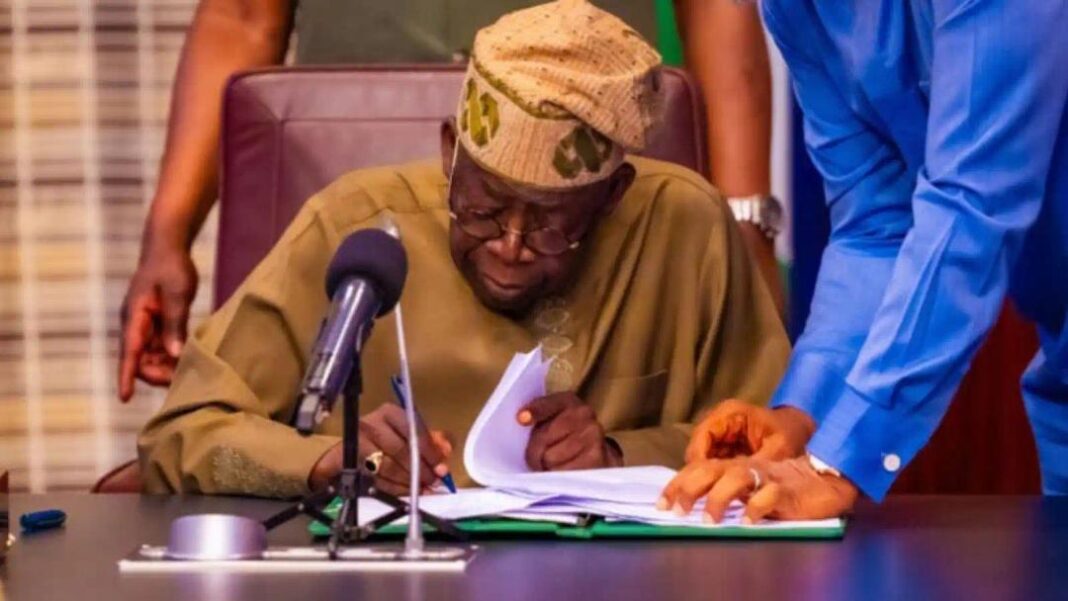
In what critics have described as a swift move to quell mounting dissent over the real-time transmission of election results, Bola Tinubu on Wednesday signed the Electoral Act, 2022 (Repeal and Re-Enactment) Bill 2026 into law, barely 24 hours after it was passed by the National Assembly.
The signing ceremony, which took place at the State House, Abuja, around 5:00pm, was attended by principal officers of the legislature. The speed of the presidential assent followed an emergency legislative process that had already drawn public outrage.
On Tuesday, lawmakers approved the Electoral Act 2026 (Amendment) Bill after the Senate endorsed electronic transmission of election results but retained manual collation as a backup. The decision triggered controversy, as civil society groups and opposition figures argued that the law stopped short of mandating real-time transmission of results directly from polling units to the central server of the Independent National Electoral Commission (INEC).
Senate President Godswill Akpabio had earlier signalled the urgency of the process during an emergency plenary convened to harmonise versions of the bill. Amid backlash over contentious amendments, Akpabio told lawmakers he expected the President to sign the bill within days.
“I believe that if you are able to conclude within this, in the next few days or one week, the President should be able to sign this amended Electoral Bill into an Act of Parliament within this month of February,” he said.
Last week, protesters comprising civil society organisations and opposition figures — including former Rivers State governor Rotimi Amaechi and Labour Party presidential candidate Peter Obi — stormed the National Assembly complex. They demanded that lawmakers enshrine compulsory live electronic transmission of results from polling units, arguing that such a measure would curb manipulation and restore public confidence in elections.
However, the ruling All Progressives Congress (APC) and some stakeholders defended a hybrid approach, citing concerns over technical limitations in areas with weak telecommunications infrastructure.
The opposition Peoples Democratic Party (PDP) reacted sharply to the President’s assent, describing the amendment as a “direct assault on democracy” and “a painful betrayal of Nigerians.”
In a statement issued Wednesday by its National Publicity Secretary, Ini Ememobong, the PDP accused the National Assembly of diluting transparency safeguards by failing to make electronic transmission from polling units compulsory.
“When lawmakers begin to dilute transparency mechanisms ahead of elections, only one conclusion is rational: there is a calculated attempt to create room for electoral manipulation,” the party said.
The PDP also criticised provisions restricting party primaries to Direct and Consensus methods, calling it an intrusion into the internal affairs of political parties and contrary to established judicial precedent affirming party autonomy.
The President’s assent came shortly after INEC unveiled the timetable for the 2027 general elections, further intensifying debate over whether the new amendments strengthen or weaken the integrity of Nigeria’s electoral framework.
Electronic transmission of results has remained one of the most contentious aspects of electoral reform since the 2023 general elections. While supporters see mandatory real-time uploads as critical to transparency, opponents within the ruling party argue that infrastructure gaps necessitate a fallback manual process.
With the ink barely dry on the new law, critics say the rapid legislative and executive action signals more than urgency — it reflects a determination to close the chapter on demands for compulsory real-time transmission, even as opposition voices vow to sustain resistance through lawful and civic means.
