By Frank Tietie
A man who is neither drunk nor high on drugs, but in his clear and sane mind, goes on a prime-time show on a continental television network like the Arise News Channel and proclaims that he got information from someone who tapped the phone line of the National Security Adviser (NSA) of the Federal Republicof Nigeria. How should the Nigerian government react?
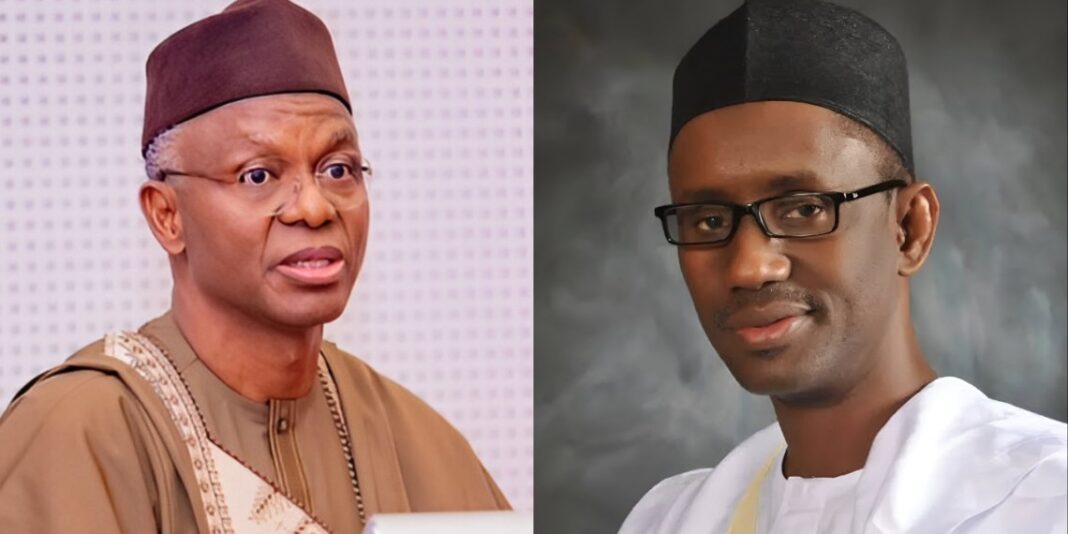
It becomes a Catch-22 for the Nigerian government whether to respond to El-Rufai’s latest tirade. But to react hastily would fail to see the damning point Nasir El-Rufai is trying to make, which is to show the ineptitude of Nuhu Ribadu as NSA. The government should have seen through the former Kaduna State governor’s bravado.
Of course, El-Rufai knows the possibility that Ribadu would fall for the trick and might actually order his detention, either for statements made on live international television or for the bared waiting fangs of the EFCC. Sonit appears he had prepared for the worst, but probably not for death in the hands of his sworn enemies through poisoning. Hence, he immediately alerted the world to the Gestapo treatment that is usually given to some government enemies when they are in detention. So he quickly accuses the same Nuhu Ribadu of importing thallium sulphate, a lethal poison suitable for eliminating political enemies quietly. This he has done, in case he, himself or any other opposition politicians die in detention as 2027 approaches. What a way to shift the burden?
The choice of the government to charge El-Rufai for cybercrimes over the claims he made on live on Arise News Prime Time show about tapping the NSA’s phone is a tacit yet loud acknowledgement that any NSA whose phone can be tapped so easily is not only incompetent, but highly undisciplined and lackadaisical on national security matters. Tell me, which serious country, like the United States of America, the United Kingdom, France, Germany, Russia, or Saudi Arabia, would take the National Security Adviser of Nigeria seriously if they knew that an ordinary citizen could easily tap his phone?
What Malam Nasir El-Rufai has done is not to present technical evidence of interception. Rather, he has thrown a political gauntlet designed to provoke a reaction. The trap is simple: once the state moves against him, the conversation shifts from the accuracy of his claim to the conduct and capability of those charged with safeguarding national security.
A hurried resort to criminal prosecution risks missing the wider implication that public officers, particularly those occupying sensitive security positions, are expected to inspire confidence, not anxiety.
Therefore, if the state frames a prosecution around a claim that the NSA’s line could be tapped, the unintended consequence is that the allegation receives international circulation, renewed media life and diplomatic attention. In effect, the courtroom becomes a megaphone for the NSA’s failures.
Consequently, if the charge against El-Rufai is driven by reputational discomfort or the political embarrassment that he has caused Ribadu or the Tinubu government. It risks being counterproductive, especially in a democratic setting that has a high tolerance for speech directed at public officials.
Statements that are provocative, speculative or even reckless are often part of political contestation, especially as 2027 approaches. They should not be the basis for criminal charges. Such statements are best answered by clarification, transparency, and institutional reassurance, rather than the coercive weight of arrest, arraignment, and trial.
To prosecute El-Rufai in circumstances such as this may therefore produce the exact opposite of deterrence. It can elevate and transform him into a cause, especiallyamong Northern Nigeria elements, and suggest that the government is more eager to punish criticism than to disprove it.
The other dimension is the possibility that such a trial would invite scrutiny, arguments, cross-examinations, and global reporting, which would further expose Ribadu or the government. Meanwhile, silence would have buried it faster.
Instead of dismissing El-Rufai as someone probably chasing political clout, the choice to charge him would validate his point and expose Nuhu Ribadu as unfit to be NSA.
El-Rufai is no ordinary politician. He combines the arts of casuistry, statecraft, populism and activism for political relevance, and he is yet on another journey to reinvent himself politically to the detriment of his foes like Ribadu. But he also wants to come out alive. And even if he dies in the process, he seems not to care much, as long as such would deal the maximum blow to the political careers of his traducers.
If anyone thinks El-Rufai is being diminished by his latest travails, they should think again. In fact, it is he who is putting some persons on trial in the court of reason.
● Tietie, Lawyer and Public Affairs Commentator, writes from Abuja.
