
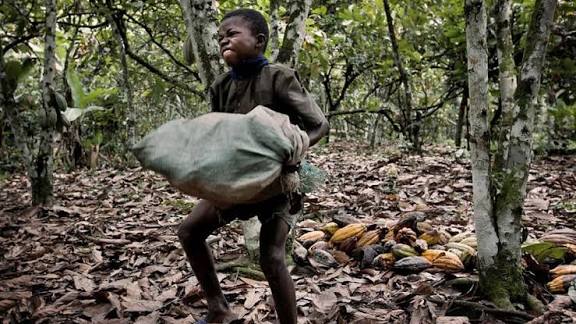
OF Nigeria’s 240 milion people, a staggering 24 million of its children aged between 5 and 17 years are involved in child labour. And this is about 15% of the world’s children in the quagmire, Everyday.ng has gathered.
Nearly 138 million children worldwide remain trapped in in this malaise, a figure the International Labour Organization (ILO) has described as “simply unacceptable,” with Africa accounting for the largest share of the global burden and Nigeria ranking among the most affected countries.
The alarming figures of the world situation were highlighted at the 6th Global Conference on the Elimination of Child Labour, hosted by the Kingdom of Morocco in collaboration with the ILO. The gathering brought together governments, employers, civil society groups, private sector leaders, academics and young people to accelerate action toward ending child labour.
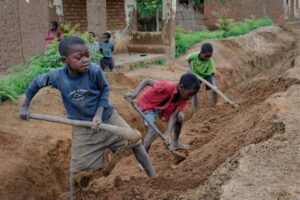
According to the latest global estimates by the ILO and UNICEF, about 138 million children – 59 million girls and 78 million boys – are engaged in child labour as of 2024–2025. Of these, 54 million are involved in hazardous work that endangers their health, safety and moral development.
Africa remains the region with the highest prevalence of child labour globally. Approximately 92 million children aged 5–17 – representing 21.6 per cent of all children on the continent – are engaged in child labour. Sub-Saharan Africa carries the heaviest share.
In Nigeria alone, an estimated 24.67 million children are involved in child labour, representing about 31.7 per cent of the country’s child population. Poverty, lack of access to quality education, insecurity and weak social protection systems are among the major drivers.
Agriculture accounts for 61 per cent of child labour globally, followed by services (27 per cent) and industry (13 per cent). In Africa and particularly in Nigeria, children are commonly found working in farming, informal mining, street trading, domestic service and small-scale enterprises.
Speaking at the conference, ILO Director-General Gilbert Houngbo acknowledged that although progress has been recorded, it has not been fast enough.
“We must admit that we failed to meet the 2025 deadline under Sustainable Development Goal Target 8.7, which requires that we simply end child labour,” Houngbo said.
While child labour has declined by more than half since 2000 and dropped by over 22 million since 2020, the global community must now move 11 times faster to eliminate the practice by 2030, he warned.
Regional progress has been uneven. Asia and the Pacific achieved a 43 per cent reduction in child labour, while Latin America and the Caribbean recorded an 11 per cent decline. Sub-Saharan Africa reduced child labour by 10 per cent, but population growth has slowed overall impact, leaving the region with the highest numbers.
Houngbo described child labour as both a moral and economic failure, warning that it undermines productivity, weakens social cohesion and limits long-term growth.
He stressed that prevention – particularly in rural areas and among younger children – must be the central strategy. Education, he said, is key.
By 2050, an estimated 80 million additional primary school places will be needed globally. The ILO is calling for greater investment in free, mandatory and quality education, alongside improved working conditions for teachers.
Other critical interventions include rural development, infrastructure investment, school feeding programmes and formalising small farms and enterprises so that adults can earn fair and living wages.
“A safe and healthy working environment which does not jeopardise workers’ lives and health is essential,” Houngbo added.
United Nations Deputy Secretary-General Amina Mohammed said the failure to meet SDG Target 8.7 demonstrates how much more needs to be done to deliver on the promise of Agenda 2030.
Ending child labour, she noted, must be embedded in broader development strategies that address poverty, inequality and the lack of decent work.
“Child labour must be illegal everywhere, and those exploiting children, including private sector actors, must be held accountable,” Mohammed said.
She urged businesses to scrutinise their supply chains to ensure child labour is not present and to act decisively where it is found.
The Doha Political Declaration, adopted at the Second World Summit for Social Development, reaffirmed global commitments to tackle the structural drivers of child labour.
For Nigeria, the statistics underscore a national emergency. With millions of children out of school and widespread poverty affecting households, experts say urgent, coordinated action is required.
Policy analysts argue that strengthening social protection schemes, expanding access to quality education, enforcing labour laws and supporting small-scale farmers and informal workers to earn sustainable incomes are critical steps.
As Africa’s most populous nation and largest economy, Nigeria’s response will play a significant role in determining whether the continent can reverse current trends.
Despite the missed 2025 target, stakeholders at the conference maintained that progress is possible. The global decline of more than 22 million child labourers since 2020 offers hope — but only if governments, businesses and communities intensify efforts.
