
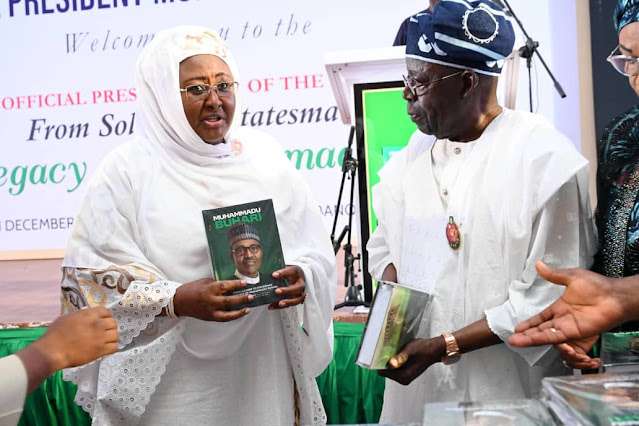
Former First Lady Aisha Buhari has made jaw-dropping revelations about the final years of her husband, the late President Muhammadu Buhari, asserting that Aso Rock gossip once convinced him she was plotting to kill him — a belief that led him to lock his bedroom door and change his routines in the Presidential Villa.
The startling disclosures are contained in a new 600-page authorised biography, From Soldier to Statesman: The Legacy of Muhammadu Buhari, authored by Dr. Charles Omole and launched at the State House, Abuja on Monday, December 15, 2025. The book, spanning 22 chapters, traces Buhari’s life from his early days in Daura, Katsina State, through his presidency, to his final days in a London hospital in mid-July 2025.
Mrs. Buhari told the book launch that, at one point, malicious rumours within Aso Rock alleged she intended to poison her husband, triggering fear and suspicion. According to accounts published today by multiple national outlets, Buhari briefly believed the rumours “for a week or so,” prompting him to lock his bedroom door and to distance himself from his wife physically and in daily routines.
The former First Lady linked the 2017 health crisis that led to Buhari’s 154-day medical leave in the United Kingdom not to foul play, but to disruptions in his carefully managed feeding schedule and nutrition plan — a regimen she oversaw for years.
Mrs. Buhari described how the loss of this routine, including missed meals and halted supplements, weakened the then-president. The biography notes that upon his return from the UK, Buhari admitted he had “never been so ill” and that doctors had administered blood transfusions.
According to the book, Aisha Buhari had long supervised a tailored meal and supplement programme for her husband — essential, she says, for a “slender man with a long history of malnutrition symptoms.” When the Presidency’s machinery took over their personal care, the routine faltered, leading to what she calls the onset of his health decline.
Dr. Omole’s biography also addresses the swirling conspiracy theories that have dogged Buhari’s health saga, noting that the president’s long absences in London spurred speculation and rumours — including claims about poisoning and even the debunked body double myth. Mrs. Buhari dismissed such theories as products of poor strategic communication and mistrust.
The book goes further, describing what Mrs. Buhari characterises as a climate of mistrust within the Presidency, alleging the use of surveillance and listening devices that compounded fear and anxiety at the Villa. These disclosures reflect deep personal tensions against the backdrop of Buhari’s final years in office.
At the launch event, President Bola Ahmed Tinubu delivered remarks highlighting Buhari’s enduring legacy, praising his discipline, modest lifestyle, and public service ethos — even as Nigerians continue to debate and reassess his years in office. Tinubu described Buhari’s leadership as anchored in integrity and service.
The biography’s revelations are already drawing attention across political and social spheres, reigniting discussions about transparency in presidential health matters, the role of inner-circle politics, and how rumours can impact governance at the highest level. Nigerians are also revisiting memories of the 2017 medical leave, a period marked by intense media speculation and political tensions.
As the nation digests these new insights, the biography in question — From Soldier to Statesman: The Legacy of Muhammadu Buhari — is likely to become a major reference in understanding not only the personal dynamics of Nigeria’s former president but also the intersections of power, perception and the human vulnerabilities of leadership.
