
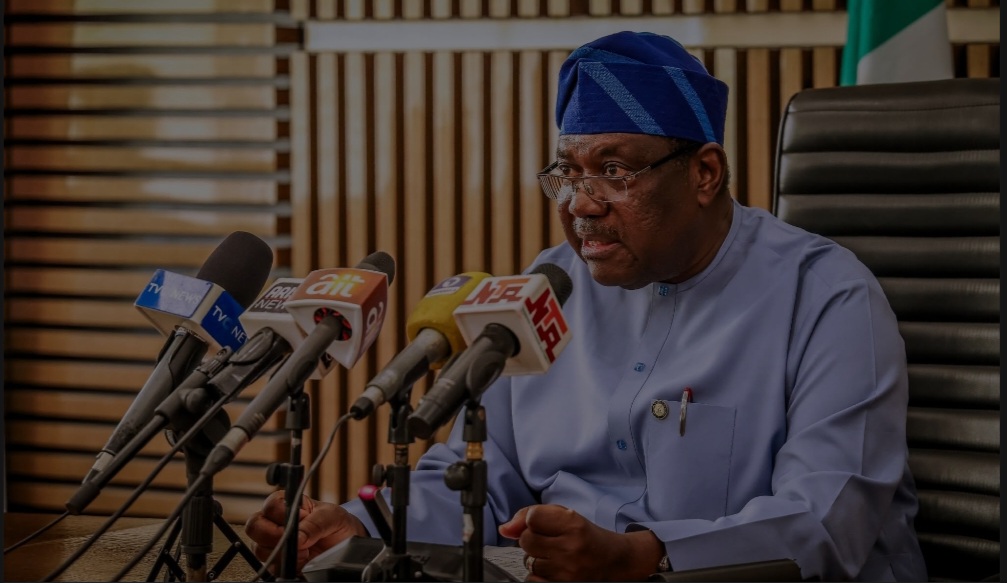
As debates and online narratives alleging a “Christian genocide” in Nigeria continue to polarise public discourse, the Secretary to the Government of the Federation (SGF), Senator George Akume, has warned that the erosion of inter-faith trust poses one of the most serious threats to Nigeria’s national cohesion.
Speaking in Abuja on Wednesday at the second triannual meeting of the Nigeria Inter-Religious Council (NIREC), Akume said the country is navigating “one of its most delicate periods,” marked by inflammatory political rhetoric, security pressures, and a growing deficit of trust between Christian and Muslim communities.
Details of Akume’s comments were contained in a statement issued by Yomi Odunuga, his Special Adviser on Media and Publicity .
For years, clashes involving farmers and herders, banditry, and insurgency have generated competing narratives—especially online—about the religious dimensions of violence. Some international advocacy groups and social-media commentators describe the situation as a systematic “Christian persecution” or “genocide,” while other researchers and security analysts argue that the conflicts are driven more by criminality, economic pressures, and local grievances than by coordinated religious targeting.
These competing stories—often amplified by viral videos, unverifiable claims, or selective reporting—have hardened public opinion along faith lines. Akume acknowledged this context, cautioning that such narratives, if left unaddressed, could “deepen suspicion, escalate fear, and obscure the shared suffering of all Nigerians.”
“Violence in Nigeria is not monolithic” — SGF
Addressing the theme “Promoting peace through collaboration: the role of inter-religious councils and government in Nigeria,” Akume stressed that both Christian and Muslim communities have suffered devastating losses from insurgency, banditry, and communal attacks.
“The point is not to engage in a scorecard of pain,” he said. “Violence in Nigeria is not monolithic. Both major faith groups bleed when any Nigerian is killed.”
He cited recent attacks from Yelwata in Benue State to Eruku in Kwara, as well as incidents across Kebbi, Niger, and Zamfara, noting that they have heightened national anxiety even as government intensifies rescue operations and arrests.
Concerns Over International Perceptions
Akume linked the urgency of restoring inter-faith trust to Nigeria’s previous designation by the United States as a “Country of Particular Concern,” saying it demonstrated the importance of strengthening domestic engagement to counter external misperceptions of Nigeria’s religious landscape.
While acknowledging diplomatic progress, he said that repairing global perceptions will require deeper collaboration between government and religious leaders in the months and years ahead.
The SGF praised NIREC’s 26-year partnership with the Federal Government, describing inter-religious councils as “vital bridges” capable of mediating conflict, dispelling misinformation, and reinforcing national unity.
He outlined priority areas for deeper cooperation, including:
▪︎Inclusive policymaking
▪︎Early-warning systems for conflict
▪︎Joint peacebuilding initiatives
▪︎Promotion of justice and rule of law
▪︎Youth education to resist hate propaganda and extremist narratives
Akume emphasised that while international partnerships are welcome, “Nigerians must work out Nigerian solutions,” adding that the government remains committed to protecting all citizens regardless of faith.
He also disclosed that President Bola Tinubu has established a new US–Nigeria Joint Working Group on Security, in which NIREC is expected to play a significant role as part of wider non-kinetic peace efforts.
Urging NIREC members to use their closed-door session for honest reflection and concrete planning, Akume appealed for unity over division.
“Nigeria will be stronger, better, and enjoy lasting peace if we collectively shame the peddlers of hatred and disunity,” he said.
The SGF insisted that rebuilding inter-faith trust is essential not only to preventing conflict but also to advancing national development and social stability.
