

 President Bola Ahmed Tinubu on Wednesday restated his government’s directive to withdraw police officers assigned to protect VIPs, ministers, and other high-profile figures, declaring the order “not negotiable.” He warned that any failure to comply would not be tolerated.
“NSA take this very seriously,” he added.
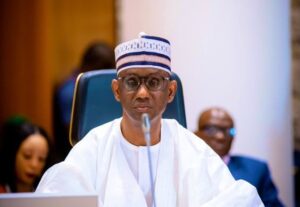
The President also urged the Vice President Kashim Shettima, who is the Chairman of the National Economic Council (NEC), to further sensitise governors and other stakeholders on the implementation of the reforms on ranching.
Speaking at the opening of the week’s meeting of the Federal Executive Council (FEC) in the State House Council Chamber, Tinubu instructed all ministers to comply immediately or seek special clearance from the Nigeria Police Force (NPF). He told those with security-sensitive assignments to meet the Inspector-General of Police (IGP) and obtain his authorisation.
The president formally tasked the Nigeria Security and Civil Defence Corps (NSCDC) — under the supervision of the Ministry of Interior — with taking over protection duties formerly shouldered by police.
According to him, the move aims to allow the police to focus on their core mandate: protecting the lives and property of citizens, especially vulnerable communities.
“Police officers were trained to protect citizens — particularly the most vulnerable,” Tinubu said. He argued that diverting them to guard a select few undermines public security, especially amid rising threats of kidnapping, banditry, and terrorism.
To enforce compliance, the IGP, Kayode Egbetokun, has already withdrawn approximately 11,566 officers from VIP protection duties and redeployed them to frontline policing roles across the country.

A special enforcement team has been constituted to monitor adherence. In Lagos, the team checked strategic locations — including the Lekki-Ikoyi Link Bridge and a major airport — and reported “satisfactory and commendable” compliance with no records of police still escorting VIPs.
Acknowledging that some public officeholders may remain vulnerable, Tinubu said exceptional arrangements could be made — but only under strict clearance. The NSCDC, he noted, is sufficiently armed and trained to carry out VIP protection.
Beyond policing reforms, the president also urged cabinet colleagues to begin implementing a broader security and livestock-ranching reform agenda — aimed at preventing conflicts between herders and farmers and reducing vulnerability of at-risk communities across rural Nigeria.
Analysts say the shift marks a major reorientation of security resources in favour of broader public-safety aims, rather than selective VIP protection.
Redeploying over 11,000 officers could improve policing coverage in underserved areas, if effectively managed.
The use of civil-defence personnel for VIP protection reduces the burden on the police — though some critics caution the change may be largely symbolic and question whether NSCDC has sufficient training or capacity for protection duties.
The reforms come amid intensifying security threats in Nigeria — including kidnapping, banditry, and communal violence — underscoring the urgency of optimizing security deployment.
On ranching, President Tinubu directed the Livestock Development Minister, Idi Muktar Maiha, to commence the mobilisation process, with particular emphasis on areas facing conflict.
“The Minister of Livestock, see which village or grazing area can be rehabilitated for ranching. We must eliminate this area of conflict and make the livestock reform economically viable.
“The opportunity is there, let’s utilise it. You should emphasise the constitutional requirement that the land belongs to the state,” he added.
Recall that following the announcement of the policy nearly two weeks it drew applause and knocks.
COMPPART Foundation for Justice and Peacebuilding’s Executive Director, Saviour Akpan, described Tinubu’s move as “necessary and courageous.” He argued that police protection for VIPs often served as a status symbol rather than a genuine security need, and that freed-up officers should be redeployed for public-safety duties.
The Rule of Law and Accountability Advocacy Centre (RULAAC) represented by Okechukwu Nwanguma welcomed the withdrawal, saying it addressed a misallocation of police resources. Nwanguma argued that the real security problem in Nigeria is not simply lack of manpower — but poor deployment and skewed priorities.
Senator Ali Ndume, supported the reform, noting that some officials have police escorts not just for themselves but for spouses and children — an excessive deployment. He urged that policing focus return to protecting communities, not individuals.
Alkali Baba, a former Inspector-General of Police praised the decision, noting it might be the first time a sitting president is ordering such a reform directly — a break from prior piecemeal or vacillating approaches. He said Nigeria’s security architecture needs a “re-jig,” and that reducing over-militarisation in civilian life is important for democratic governance.
However, the African Democratic Congress (ADC) through its spokesperson Mallam Bolaji Abdullahi, dismissed the withdrawal as “political theatre.” ADC argued the move fails to address the root causes of Nigeria’s insecurity, such as terrorism, banditry, and mass abductions. It warned that simply moving officers from VIP protection to “core policing” does little if there is no overarching, coherent security strategy.
The ADC also questioned the substitution of police with the Nigeria Security and Civil Defence Corps (NSCDC) for VIP protection — describing the agency as ill-equipped for counter-terrorism or high-risk protection duties. According to them, replacing police with civil-defence personnel may not meaningfully improve security.
Denge Josef Onoh, a former state lawmaker from Enugu publicly urged reconsideration of the decision. He warned that removing police protection from VIPs — especially in a climate of widespread kidnappings and criminal violence — might endanger public officials, bureaucrats, or other high-profile individuals and turn them into easy targets.
Abutu Yaro (retired Assistant Inspector General of Police) advised that the withdrawal needs to be handled with “serious caution.” He pointed to historical precedents where public figures lost their lives after being left without protection, arguing the reform could have “regrettable” consequences if implemented hastily. Channels Television
Some security analysts have cautioned that even though more than 11,000 officers have been recalled (per Nigeria Police Force — NPF), the gains may be limited if there is no accompanying improvement in training, logistics and overall strategy to tackle terrorism, banditry and kidnapping.
Civil-society voices argue the reform must be accompanied by a holistic restructuring — including welfare for police officers, better intelligence and community policing — if it is to genuinely improve national security.
