
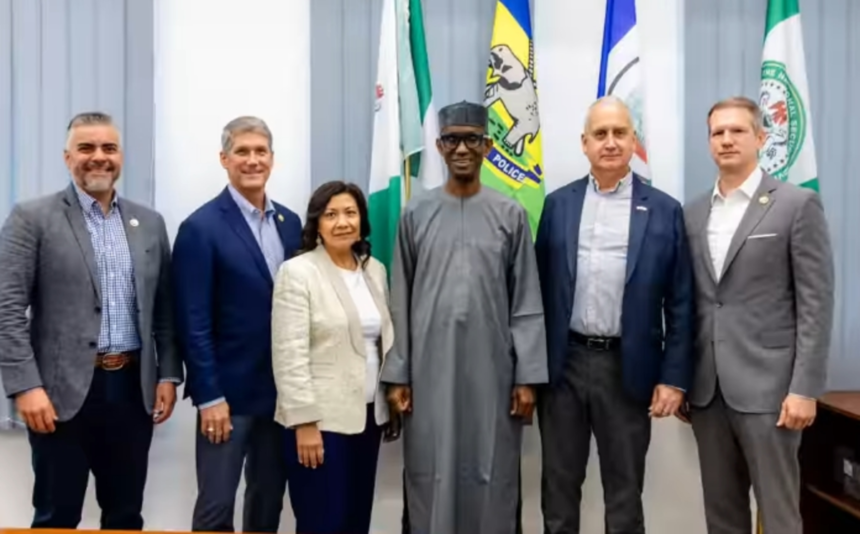
A U.S. Congressional delegation arrived in Nigeria today for a high-stakes fact-finding mission aimed at probing allegations of widespread attacks on Christian communities across Nigeria. The visit marks a deepening of U.S. legislative and diplomatic engagement with Nigeria’s security challenges, at a time of intensifying international scrutiny.
Led by Representative Riley M. Moore, the delegation includes Reps. Mario Díaz‑Balart, Norma Torres, Scott Franklin and Juan Ciscomani, and was joined by the U.S. Ambassador to Nigeria — Richard Mills — underscoring the diplomatic weight of the engagement.
According to Nigeria’s National Security Adviser, Nuhu Ribadu (NSA), the delegation’s visit “follows earlier high-level security talks held in Washington, DC” and aims to deepen cooperation on counter-terrorism, regional stability and strategic security partnership between Nigeria and the United States.
Ribadu called the meetings “productive and timely,” highlighting shared commitment to peace and security.
The visit comes amid growing U.S. pressure on Nigeria over alleged killings and violence against Christian communities. On December 3, the U.S. State Department announced visa restrictions targeting individuals and their families deemed responsible for “mass killings and violence against Christians,” under the powers granted by Section 212(a)(3)(C) of the Immigration and Nationality Act.
This move follows the recent re-designation of Nigeria as a “Country of Particular Concern (CPC)” for alleged religious-freedom violations — a shift that has rattled diplomatic relations.
Earlier this week, a joint briefing convened by the U.S. House Appropriations Committee and the House Foreign Affairs Committee heard testimony from religious-freedom and foreign-relations experts. The briefing was called to examine what U.S. lawmakers described as “escalating violence and ‘targeted persecution’ of Christians in Nigeria.”
In response, the Federal Government has strongly rejected characterisations of the violence as religious persecution or “genocide.” Nigeria maintains that its security crisis — involving terrorism, banditry, violent extremism, and communal land/resource conflicts — affects both Christians and Muslims. Government officials argue that labeling the conflict as Christian-specific ignores the complex, overlapping nature of Nigeria’s security challenges.
At a diplomatic briefing in early November, the government described the U.S. CPC designation as based on “misinformation and faulty data.”
Legislative responses have mirrored this stance. The House of Representatives of Nigeria — unanimously rejected a proposed U.S. Senate bill that sought to punish Nigerian officials for alleged religious killings, calling it a “gross mischaracterisation” of Nigeria’s security and religious-freedom landscape. The lawmakers asserted that Nigeria’s Constitution guarantees freedom of religion and that the crisis should not be framed as an attack on a specific faith.
Meanwhile, government spokespersons emphasise that efforts to eradicate violent extremism remain ongoing, and commit to further cooperation with foreign partners — including the U.S. — to protect all citizens.
As of today, the U.S.–Nigeria delegation concluded its Abuja meetings. Federal Government representatives have reaffirmed their commitment to working with the U.S. on security issues, including counter-terrorism cooperation, joint intelligence sharing, and a new joint Working Group recently approved by President Bola Tinubu.
At the same time, U.S. lawmakers in Washington continue to push for accountability — from possible visa bans to broader legislative measures — if the government fails to convincingly address the violence against Christian and other vulnerable communities.
For Nigeria, the stakes are high. The government must balance cooperation with international partners while defending its sovereignty and reputation, navigating domestic political sensitivity around religion, and delivering meaningful security improvements in a context of deep-seated instability.
The presence of senior U.S. lawmakers and the envoy signals that Washington is treating the issue not just as humanitarian concern but as a foreign-policy and security priority.
Policy consequences: Visa restrictions and the CPC designation mark a shift from rhetoric to concrete punitive or coercive diplomacy — raising the costs of inaction.
A dual-track response is likely in a manner that the country receives increased intelligence, humanitarian and security cooperation — while facing heightened external scrutiny and condition-based aid or support.
During their visit to Benue State—one of the regions most affected by violence—the U.S. officials also held discussions with key religious and traditional leaders, including the Bishop of the Catholic Diocese of Makurdi, Most Rev. Wilfred Anagbe; the Bishop of Katsina-Ala Diocese, Most Rev. Isaac Dugu; and the Tor Tiv, His Royal Majesty James Iorzua Ayatse.
NSA Ribadu described the engagement as both “productive and timely,” noting that discussions focused on strengthening counter-terrorism cooperation, improving regional stability in West Africa, and expanding strategic security ties between Nigeria and the United States amid evolving global threats.
“We are committed to building stronger ties with the United States. This engagement will deepen trust, collaboration, and our shared commitment to peace and security,” Ribadu said.
Following a meeting with Bishop Anagbe, Congressman Moore posted on X:
“I came to Nigeria in the name of the Lord and on behalf of the American people. Just ending a very productive Congressional visit to Nigeria! We had rounds of meetings with the Nigerian government and people on the ground, including stops in Benue State. More details to come. Happy Sunday. God is Great!”
