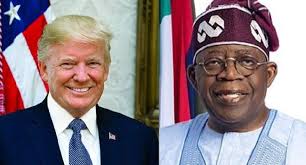
As President Bola Tinubu named three oni-career ambassadors for the United States of America, France, and the United Kingdom, a group known to always back him, The Democratic Front (TDF), says the conclusion of the recent high-level talks between Nigerian and U.S. officials marks a major diplomatic triumph for Nigeria. According to the group’s Chairman, Mallam Danjuma Muhammad, and Secretary, Chief Wale Adedayo, it vindicates the diplomatic approach taken by President Bola Tinubu.
The nominees, whose names were sent to the Senate for confirmation are Col. Kayode Are, Ambassador Ayodele Oke, and Amin Mohammed Dalhatu
Ambassador Oke, a former Director General of the National Intelligence Agency (NIA), served as Nigeria’s ambassador to the Secretariat of the Commonwealth of Nations in London, while Are was Director-General of the Department of Services (DSS) from 1999 to 2007, and National Security Adviser in 2010. Ambassado Dalhatu served as Nigeria’s ambassador to South Korea during President Buhari’s administration.
The nominations come as details of a US Congress resolution on Christian genocide in Nigeria began making the rounds on the social media.
Meanwhile, TDF argues that by responding calmly and non-confrontationally to what many viewed as provocative remarks by U.S. President Donald Trump — specifically, allegations of genocide against Christians in Nigeria — Tinubu laid the groundwork for a reset in bilateral relations. The TDF sees the ensuing agreement as a “remarkable victory” for Tinubu’s measured tone, which they say helped avert what could have become a full-blown diplomatic crisis at a time when Nigeria lacked substantive ambassadors abroad.
In their view, the outcome — a new, cooperative security partnership involving intelligence sharing and potential supply of defence and security equipment — shows that Nigeria is back on a path of constructive engagement rather than confrontation. They believe this turn demonstrates that the Nigerian government is firmly in control and committed to defending the country’s interests, despite pressure from aggrieved groups who insist there are genocidal killings in the country. In that light, the TDF calls on Tinubu to continue deepening ties with the U.S. to tackle Nigeria’s security and socio-economic challenges.
The Nigerian delegation — led by its National Security Adviser — used the meetings in Washington to formally reject the genocide allegations, arguing that violent attacks in Nigeria affect people across all religious and ethnic lines, not Christians alone.
They presented data and evidence to seek to correct what they say is a “misleading narrative,” insisting that insecurity in Nigeria is rooted in terrorism, banditry, communal conflicts and crime — not in state-sponsored religious persecution.
On the U.S. side, despite earlier aggressive rhetoric — including threats of military intervention and re-designation of Nigeria as a “Country of Particular Concern” (CPC) — officials after the talks pledged renewed support: deeper security cooperation, enhanced intelligence sharing, faster processing of defence-equipment requests, and possible supply of surplus defence articles to Nigeria, subject to availability.
The Americans also committed to humanitarian assistance for affected communities and technical aid to bolster early-warning and conflict-prevention mechanisms — indicating a shift toward partnership and support, rather than confrontational threats.
Everyday.ng reports that no word on the talks has come from the Americans on the talks other than an acknowledgement of the visit by Pete, the US Secretary of War, in a social media post.
Recall that a new resolution introduced last week Tuesday in the U.S. House of Representatives has sharply condemned the persecution of Christians in Nigeria and signaled congressional readiness to support President Donald J. Trump should he pursue decisive measures against what lawmakers describe as an “existential threat” facing Nigerian Christians.
The resolution, submitted by Rep. Riley M. Moore (R-WV) and referred to committee for review, outlines a sweeping indictment of Nigeria’s security and human-rights record, citing years of mass killings, church burnings, kidnappings, and systematic attacks attributed to Boko Haram, Islamic State West Africa Province (ISWAP), and Fulani militant groups.
A Record of Violence and Displacement
Drawing on documented trends since 2009, the resolution states that between 50,000 and 100,000 Christians have been killed in Nigeria over the past 16 years, with over 7,000 deaths recorded in 2025 alone—an average of 35 killings per day. It further notes that more than 19,000 churches have been attacked or destroyed over the same period.
Benue and Plateau States, two hotspots of targeted violence, are highlighted as particularly devastated regions. According to the resolution, more than 9,500 people—mostly Christians—were killed in the two states between May 2023 and May 2025, and over half a million residents were displaced.
The document describes the attacks as deliberate campaigns of religious cleansing, pointing to coordinated assaults on Christian holy days, including the 2022 Pentecost Massacre, the Christmas Eve 2023 Massacre, and the Holy Week 2025 killings, which together claimed hundreds of lives.
The resolution sharply criticizes Nigerian authorities for failing to prevent attacks or protect vulnerable communities. It cites the October 14, 2025, massacre in Rachas village, where a local pastor warned of an impending Fulani offensive—warnings dismissed by the Nigerian Army as “fake news.” At least a dozen Christians were killed the next day.
The resolution also expresses concern that Nigeria’s federal leadership continues to deny religious persecution. President Bola Ahmed Tinubu said in September 2025 that “there’s no religious persecution in Nigeria,” a claim lawmakers argue contradicts “overwhelming documentation.” Tinubu reiterated his position after President Trump reinstated Nigeria as a Country of Particular Concern (CPC) on October 31, 2025.
Blasphemy Laws Under Scrutiny
Nigeria remains one of seven countries where blasphemy is punishable by death under state-level Sharia provisions. According to the resolution, these laws have led to imprisonment, mob attacks, and murders involving Christians and minority Muslims, citing the cases of Rhoda Jatau and Deborah Yakubu.
International bodies, including the United Nations, European Parliament, and ECOWAS Court of Justice, have condemned Nigeria’s blasphemy regime as a violation of global human-rights standards.
The resolution draws contrasts between U.S. administrations. It notes that President Trump designated Nigeria as a CPC in both 2020 and 2025, unlocking potential sanctions and diplomatic pressure. Conversely, the Biden administration’s 2021 removal of Nigeria from the CPC list is described as coinciding with an escalation in violence.
The U.S. Commission on International Religious Freedom (USCIRF) has recommended CPC designation for Nigeria every year since 2009.
What the Resolution Calls For
If adopted, the House would:
• Condemn the persecution of Christians and the Nigerian government’s failure to act.
• Express readiness to support President Trump in taking decisive actions.
• Urge the U.S. government to use diplomatic, economic, and security tools to pressure Nigeria to:
• End impunity for religiously motivated violence,
• Protect Christian communities and clergy,
• Facilitate the safe return of displaced persons, and
• Repeal blasphemy laws and free detainees held for their faith.
• Encourage international coordination on humanitarian aid delivered through trusted NGOs and faith-based groups.
• Affirm U.S. solidarity with persecuted Christians in Nigeria.
The resolution has been referred to committee, where hearings or amendments could follow before any vote takes place on the House floor. While non-binding, the measure represents one of the strongest congressional statements on Nigeria in recent years and signals potential shifts in U.S. policy—particularly as the Trump administration weighs options under the CPC designation.
