

By Adebayo Adedeji
In a trend that is gaining ground in Lagos, many families in the Itesiwaju Ajumoni Community Development Area of Oworonshoki, the early hours of an October night will forever be the moment their home ceased to exist in the way they knew it.
They woke to the roar of machinery, the crack of walls being pulled down, teargas drifting through narrow lanes and neighbours rushing to salvage whatever they could — mattresses, cooking pots, toys, a photo frame or two. Among them was a mother of three whose voice trembled as she tried to explain:
“We had just fallen asleep when the shouting started… we ran out with our children, left everything behind.”
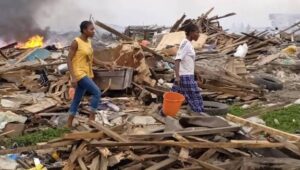
That family is among more than 100 properties, according to human rights lawyer and Senior Advocate of Nigeria Femi Falana, which were demolished in defiance of a court order issued by the Lagos State High Court.
On 23 October 2025, Justice Adegboyega Balogun granted an interim injunction halting further demolition of properties on Ojileru Street, Ososa Extension and Toluwalase Street in the community. Residents say they had neither received compensation nor even been served proper warning.
And yet, Falana says, the state authorities “mobilised over 50 armed policemen and thugs who fired teargas throughout the night… and proceeded to commence a fresh demolition”.
For the families whose dwellings were razed:
• The walls that once rang with children’s laughter now lie in rubble.
• Neighbours who knew and shared in each other’s joys now struggle to find where to go.
• What was once community — Sunday snacks, chats on the street, children running in the open — has been fractured.
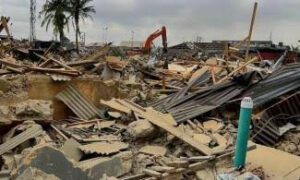
One resident said:
“What will we do without a place to call our own?”
Their displacement raises questions far beyond bricks and mortar: Where will the children sleep tonight? What about their studies? What about the women whose small informal businesses ran out of their homes?
From the government side, represented by officials from the Lagos State Building Control Agency (LASBCA) and the Ministry of Physical Planning:
• The buildings were unapproved, in “distressed” states, on drainage paths or on land owned by the state — thus posing threats to life and safety.
• Notices had been served during an amnesty period (from May 2024 to December 2024) for owners to regularise. Many reportedly did not.
• The government also said it would not compensate owners of illegal structures — “Should we use taxpayers’ money to pay somebody for an illegal structure? Is that fair? No,” said Commissioner Oluyinka Olumide.
So: from the government’s view, they were enforcing planning regulations; from the residents’ view, the enforcement was at best sudden, at worst unlawful.
Falana’s warning: “In flagrant breach and contempt of the subsisting court order… the action of the demolition squad is a sad reminder of the government’s disregard for due process.”
For many observers, this case illustrates the tension between development/regulation and human rights/community protection. When entire neighbourhoods disappear overnight, the human stories behind the statistics often fade.
Looking ahead: questions that need answers
• What alternative accommodation or resettlement plan has been offered to the displaced families?
• Will there be a verification of who genuinely owned or lawfully occupied these homes, and who was informal?
• How can the state ensure both safety (through enforcing standards) and justice (through fair process and compensation where appropriate)?
• What dialogue exists between the government, the community, and independent human rights actors going forward?
In their words “We’re not just losing our homes, we’re losing our livelihoods and our sense of community.” — A displaced resident was quoted as saying.
“The government cannot allow people to live in houses that are not fit for habitation.” — Ministry official.
Beyond the court rulings and official positions lies the reality of human lives changed in an instant: bedrooms turned to rubble, families without shelter, children wondering where tomorrow’s school bag will hang.
The story of Oworonshoki is not just about land or legality. It’s about people, about homes, about belonging — and about whether these will matter when the dust settles.
