
•● The context, counterviews, international comparisons and reform
By Group Captain Sadeeq Garba Shehu (rtd)
1. Context: The Recent Changes
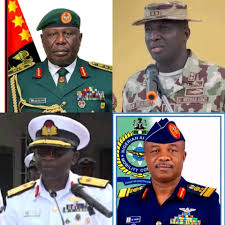
Following the President’s recent exercise of his constitutional powers to nominate new Service Chiefs (pending NASS confirmation), the Chief of Defence Staff Gen CG Musa (38 RC), CNS Vice Admiral Ogalla (39 RC) and CAS Air Chief Marshal Hassan (39 RC) were dropped. Lt Gen Oluyode (originally 39 RC, now 40 RC) was moved to CDS.
The new nominees are:
• COAS: Maj Gen W. Shuaibu (41 RC)
• CNS: R/Adm I. Abbas (40 RC)
• CAS: AVM SK Aneke (40 RC)
This means the most junior among them is 41 RC. By long-standing Nigerian military tradition, all officers senior to the most junior Service Chief are expected to “voluntarily” retire.
For example under late PMB, when by then R/Adm AZ Gambo (36 RC) was appointed CNS together with Gen Irabor (34 RC) late Gen Attahiru (35 RC) and Air Chief Marshal Amao (35 RC ) as CAS, all 35 RC Major Generals and equivalent in Navy and NAF (ie all those senior to AZ Gambo as the most Junior Service Chief) were requested to “voluntarily retire.” This mass purge even got worse when after the untimely death of late Gen Attahiru (may his soul rest) Gen F Yahaya 37 RC was appointed COAS becoming the most junior among the Service Chiefs forcing 100+ Major Generals and equivalent in Navy and Air Force (few 35 RC many 36 RC ) to take an early shower. In 2023 when PBAT appointed his service chiefs he jumped 38 RC (except Gen Gwabin CDS) and picked from 39 RC precipitating the mass retirement of 38RC with several years remaining in their career.
These recent appointments when confirmed are expected to trigger a similar wave involving Major Generals and equivalent in RC 39 and 40 . We do not know the exact number to be affected but in the Army alone some 48 of them. Note the arbitrarily agreed cut of point is the seniority of the most junior Service Chief.
2. Key Concepts: Succession and Supersession
Now in the field of military officers career management and progression, the military being a very hierarchical organization, the usual normal path is through SUCCESSION. But along the way through what I personally call “military snake and ladders” SUPERSESSION can also occur.
• Succession → orderly, merit-based advancement in line with seniority, competence, and established hierarchy.
• Supersession → bypassing seniority when a junior officer is appointed over more senior colleagues.
Succession is usually based on seniority + merit , it is predictable and stabilising , it has positive effect on morale , it allows for smooth transition and is guided by a succession plan.
On the other hand supersession is usually based on discretion/politics, it can have a destabilising effect, it often (not always) has negative effects on morale, it often leads to mass retirement, it is very sensitive and requires careful management.
3. The Traditional Nigerian Military Practice
In Nigeria’s armed forces, an unwritten but powerful norm says: “Your senior is your senior for life, and your junior is your junior for life.” This has long meant that once a junior is appointed above them, senior officers take personal or institutional decision to retire almost immediately — often even before formal instructions are issued. This mirrors a British-influenced seniority culture that has shaped Nigerian military command tradition for decades.
4. The Counter-Argument: Officers’ Right to Serve Out Their Tenure
In recent years, however, a growing number of officers and civilian observers have begun questioning this unwritten rule. Their argument is simple and legalistic:
• The officers signed to serve for 35 years, not “until a junior is appointed.”
• Supersession, while politically permissible, should not automatically compel their retirement.
• Officers should have the right to choose whether to remain in service or retire, so long as they remain professionally loyal to the chain of command.
• Voluntary retirement must be voluntary in fact, not just in name.
This view reflects an evolving professional culture and a push for institutional reforms that could modernise how supersession is managed in Nigeria.
5. International Comparisons How do Other Countries Militaries Handle this
In almost all democratic countries the President retains the powers to nominate and after confirmation by parliament appoint Service Chiefs. Most Presidents will try not to cut too low to appoint a junior but when they do how is it handled?
In India, the by passed officers retire soon after in order to preserve decorum.
In the US, the superseded officer may decide to stay, no compulsion to retire early.
In UK, option to retire or stay and accept a ceremonial non-command position in order to avoid awkward hierarchy.
In Pakistan, it is immediate retirement due to a strong seniority culture.
In Egypt, it is reassignment or retirement due to the strong political control that the Egyptian military has.
In France, such officers are reassigned to NATO/EU roles outside the national military.
Key point:
Countries with strong seniority traditions (Nigeria, India, Pakistan, UK) see supersession trigger retirements. In merit-based systems (like the U.S.), officers can stay on, respecting the new chain of command.
The major difference with other countries is that while in other countries this affects only relatively few Generals. In Nigeria, those affected could reach over 100.
6. Implications of Supersession in Nigeria
1. Mass Retirement of Senior Officers – sometimes involving 100+ generals.
2. Perceptions of Politicisation – seen as Presidential preference over merit.
3. Career Planning Uncertainty – mid-career officers view promotions as unpredictable.
4. Erosion of Seniority as a Stabilising Factor – weakens institutional trust.
5. Talent Drain – loss of experienced Generals and institutional memory.
6. Command Cohesion Challenges – quiet resentment may weaken unity of effort.
7. Potential Advantages
• Generational Renewal: Younger officers take command roles.
• Clearer alignment with the Commander-in-Chief’s strategic direction.
• Accelerated reforms when transition is well-managed.
But without transparent rules, these benefits can be overshadowed by morale loss and institutional distrust. Right now we do not have transparent rules of doing this. It is done haphazardly, in fact, we cannot say precisely who determines if such officers should go or should remain; sometimes you are told it is for the incoming Service Chief to decide (which I think is wrong because of his not being their employer should not have the powers to terminate their careers.
It is not the Minister of Defence, it is not the President as often these two don’t even put much eye on such matters.
In fact I know of a case where a Service Chief on his own decided that Gen X should stay, Gen Y should go…. arbitrarily. Certainly, there is need for reforms and this issue has been discussed at the two Committees of Reform for the Nigerian military during PMB, committees in which I have had the honor of serving but no implementation.
8. Policy and Institutional Reform Recommendations
I will give my humble recommendations. To reduce negative impacts and respect officers’ rights while ensuring professional command:
• Codify clear unambiguous rules on supersession, promotion boards, and early retirement options. This is the work of NASS.
• Recognize the right of officers to choose whether to stay or retire after supersession, provided discipline and loyalty are maintained.
• For officers who choose to leave (military traditionalist puritans like me who believe My Junior is My Junior for life) calculate their remaining service life and pay them off.
• Create structured post-retirement pathways (e.g., advisory councils, defence diplomacy etc).
• Reinforce transparent selection criteria to reduce perceptions of favouritism.
• Clearly define tenure of Service Chiefs.
• Develop a talent management system balancing renewal with institutional continuity.
• Cap the number of generals to minimise collateral career casualties. This again is NASS responsibility.
In Summary
Supersession in military appointments is legal and common in many countries, but how it is managed determines its impact. Nigeria stands at a crossroads between old traditions and modern personnel management.
Respecting both institutional discipline and individual rights of service will be key to ensuring:
• Stronger morale,
• Reduced politicisation,
• Preservation of experience, and
• A more predictable command environment.
Supersession-triggered early retirement of 100+ senior officers at once, as seen in Nigeria (e.g., after the appointment of Gen Yahaya in 2021), has very few historical parallels in world militaries and quite rare internationally. This is exceptional globally, especially for the Nigerian military of roughly 250,000–300,000 personnel.
In India such selective supersession is in a much smaller scale . The Appointment of Gen Bipin Rawat as COAS in 2016 over two more senior officers affected only senior generals immediately retired; others were unaffected.
In Pakistan, the appointment of Gen Bajwa (2016), Musharraf (1998), others affected only 4–10 lieutenant generals.
In UK, Supersession occurs occasionally, but mass early retirements of senior officers are rare.
In Turkey 2016, China (2015-17) and Russia (early 1990s) large number of generals were indeed retired but it was in a different context: These involved purges or structural downsizing, not routine supersession. 100+ generals were affected in Turkey’s 2016 post-coup purge, but that was political and security-driven, not a traditional leadership change.
Key Point
Nigeria is virtually alone among all world militaries in triggering 100+ retirements purely through routine supersession. In my research, no other military regularly retires 100+ Generals simply because a junior was appointed.
THERE MUST BE SOMETHING WRONG WITH THE SYSTEM.
If we are retiring 100 Generals at once or even 50, something other world militaries do not do, then certainly there is something wrong with the system that needs fixing. In my humble opinion, with no military or security experience himself, with no FEC/Cabinet member with any military experience, President Tinubu needs a seasoned Adviser on Military Affairs by whatever name to assist him in understanding these issues. The wastage is colossal.
Similarly, the National Assembly has a very big role in passing subsidiary legislations or amending the AFA (Armed Forces Act) and reviewing the HTACOS (Harmonised Terms and Condition of Service) if these issues are to be resolved.
There are also very germane recommendations in the reports of the two Committees set up under PMB for the Reform of the Armed Forces…Reports which are gathering dust. The Nigerian Military indeed the whole Nigerian Security Sector needs reform.
Asiwaju Bola Ahmed Tinubu, Kashim Shettima Nigerian Senate, House of Representatives, Federal Republic of Nigeria The Senate President – Nigeria Jake Dabang Dan-Azumi @DCAF
I end with what “Voluntary Retirement” means in Nigerian military language. There are two types: 1. An officer or soldier, on his own volition puts in his paper “I want to go”. This coincides with the dictionary meaning of VOLUNTARY.
But there is a second type of Voluntary retirement which is at odds with the OXFORD dictionary meaning of VOLUNTARY. In this case, the officer let me say, is “ordered” to “voluntarily” write a letter asking for his retirement. If you still don’t get it – it is a military order meaning ‘You either jump or we push you.’
● Group Captain Shehu (rtd) is a security sector reform consultant and former spokesman of the Nigerian Air Force
