
By Ogwu OmaOmale, Abuja
The House of Representatives has today resolved to establish an ad‑hoc committee to probe the government’s investment of US$460 million (about N736 billion) in a closed‑circuit television (CCTV) surveillance project in the Federal Capital Territory (FCT), Abuja.
Every National Assembly in the last 15 years has probed the project with no executable report, amid allegations of compromises by Federal lawmakers, who make a lot of noise at the beginning but end up delivering no workable report.
In fact, the project to cover the Federal Capital City has been described as an “oil well where noise is made, pockets are lined and graveyard silence follows until another National Assembly is inaugurated.”
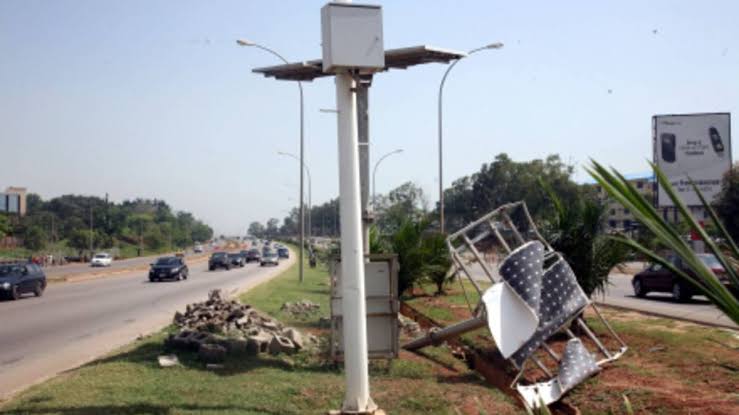
Everyday.ng observed that many of the cameras, cables, poles, solar panels “simple grew legs and walked away, while others were thoroughly vandalised in the last decade.”
During Wednesday’s plenary, the motion brought by Amobi Ogah (Labour Party – Abia) was adopted. He argued that one of government’s foremost duties is the protection of lives and property and the entrenchment of security as a foundation for good governance.
Moving the motion, Ogah recalled the initiative under the administration of Goodluck Jonathan, which contracted the installation of CCTV cameras around strategic areas of Abuja to curb crime, provide surveillance on suspected criminals and aid law‑enforcement. He noted that the then Finance Minister, Olusegun Aganga, led a delegation to Beijing in 2010 where a Memorandum of Understanding (MoU) was signed with ZTE Corporation of China for the system.
According to the lawmaker, the funds for the contract were secured through a US$460 million loan from the China‑EXIM Bank, drawn from a US$600 million financing portfolio offered as a soft‑credit, with repayment scheduled over 10 years after a 10‑year grace period.
Ogah expressed deep concern that despite the huge investment and the burden of servicing the loan, the CCTV system has delivered little to no visible impact. Instead of declining, crime in Abuja continues to rise — including fatal incidents in supposedly “monitored” zones of the FCT. “Nigeria is paying heavily for this loan … to execute the non‑functional CCTV contract … this leaves the country in a lose‑lose nightmare,” he asserted.
Supporters of the motion described the project as “poorly executed” and lacking proper feasibility, rendering the system vulnerable both technically and operationally.
Under the direction of Deputy Speaker Benjamin Kalu, the House mandated further legislative action: committees on National Security & Intelligence, Finance, and Public Accounts have been tasked to conduct the investigation.
The ad‑hoc committee will examine several issues, including:
• Status of the contract awarded to ZTE and its implementation to date.
• What portion of the US$460 million has been drawn, paid out, and to which contractors/local partners.
• Whether the system is operational, and if not, what work was completed (and how).
• Current debt‑service obligations for the loan and whether these are justified given lack of outcomes.
• Identification of any accountability gaps or mis‑management of funds and assets.
This is not the first time questions have been raised about the project. In 2019, the Socio‑Economic Rights and Accountability Project (SERAP) sued the government for failing to disclose information on the loan, the contractors, payments and project status.
In May 2023, a Federal High Court in Abuja ordered the government to account for the loan: publish the total amount paid to contractors (Chinese and local), the names of companies involved and the status of project implementation.
A 2016 investigation revealed that parts of the project were in ruins: poles and solar‑powered cameras lying vandalised in Abuja, suggesting a completed project had never become operational.
Moreover, procurement irregularities were flagged: the Bureau of Public Procurement stated that the project for CCTV installation in Abuja and Lagos did not obtain due‑process certification before award.
The unfolding probe raises several broader issues:
• Value for money: A substantial loan has been committed — but citizens in Abuja appear to have derived little tangible benefit.
• Debt burden: Nigeria continues to service the loan repayment despite the project’s limited output.
• Procurement and oversight: The absence of due‑process certification and long delays in functionality suggest weak governance.
• Security stakes: The original rationale – to bolster surveillance and reduce crime in the Federal Capital – remains unfulfilled, raising serious questions about public safety.
• Accountability: The judicial order for disclosure and the new House committee indicate pressure building for transparency and remedial action.
The ad‑hoc committee will begin investigations shortly. Findings and recommendations are expected to be submitted to the full House. Possible outcomes include: sanctions or referral to anti‑corruption agencies, recovery of funds, restructuring of the surveillance system, or cancellation of the existing contract and reconsideration of how best to deploy such a system.
Government officials from the Ministry of Finance, the Federal Capital Territory Administration, law‑enforcement agencies, and the contracted firm(s) will likely be called to appear before the committee.
The House’s action signals renewed legislative scrutiny of large‑scale security‑infrastructure deals, especially those financed by external loans and yielding minimal outcomes. For the citizens of Abuja — and the Nigerian taxpayer — the key questions now are: how much was spent, for what, and where are the cameras? And, critically: when will the system work as promised?
As the ad‑hoc committee gets to work, the spotlight is firmly on accountability, transparency and the imperative that public funds deliver public value.
