
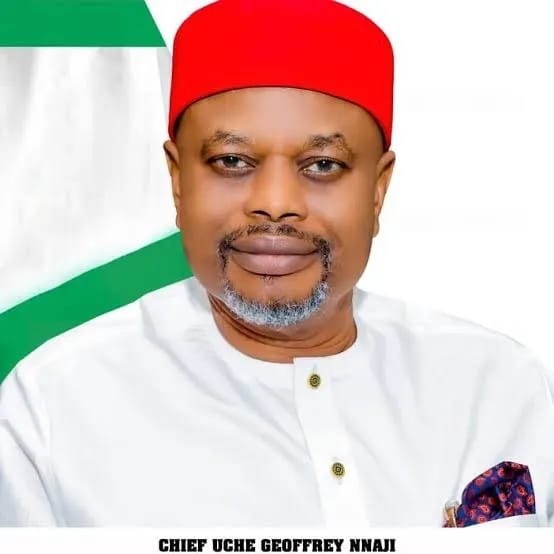
The African Democratic Congress (ADC) has launched a scathing critique of President Bola Tinubu’s administration over its continued retention of Minister of Innovation, Science and Technology, Chief Uche Nnaji, amidst swirling allegations of certificate forgery.
In a strongly worded statement issued by its National Publicity Secretary, Mallam Bolaji Abdullahi, the party condemned what it described as the government’s tolerance for “corruption in all its forms.” The ADC pointed to mounting evidence suggesting that the academic certificates presented by Nnaji may have been forged — allegations the Minister has firmly denied.
According to the ADC, official correspondence from the University of Nigeria, Nsukka (UNN) and the National Youth Service Corps (NYSC) appears to contradict Nnaji’s academic claims. Even more damaging, the party said, is a court filing reportedly made by the Minister himself, in which he allegedly admits that UNN never issued him a degree certificate — a detail that has fueled growing calls for his resignation.
“The President’s silence is not just puzzling — it is a quiet endorsement of fraud,” the ADC said. “This is a government that has shown, again and again, that questionable credentials are no disqualification for high office.”
Despite the controversy, Nnaji remains active in his ministerial role, representing Nigeria at both domestic and international engagements. The ADC called his continued presence in office “a great disservice” to the country.
“If the Minister is not honourable enough to resign, why is the Tinubu administration still keeping him in office?” the statement questioned. “By refusing to act, the government is mocking its own anti-corruption stance.”
A Pattern of Deception?
The ADC claims this scandal is part of a broader pattern within the ruling All Progressives Congress (APC), citing past controversies involving forged or questionable academic credentials among top officials.
“These recurring scandals reflect a party that is foundationally accommodating of deceit,” Abdullahi said, warning that a government’s credibility begins with the integrity of its officials.
The ADC called for Nnaji’s immediate suspension and an independent investigation, while also urging the Senate and Department of State Services (DSS) to review their vetting procedures for political appointees.
“Certificate forgery is not a clerical error — it is a crime. And if proven, it must attract the full weight of the law,” the party insisted.
Minister Uche Nnaji Responds: “This Is a Political Witch-Hunt”
In response to the allegations, Minister Uche Nnaji has maintained that he is a proud alumnus of the University of Nigeria, Nsukka, having graduated in July 1985 with a Bachelor of Science degree in Microbiology/Biochemistry (Second Class Honours, Lower Division).
At a press briefing held in Abuja on September 6, 2025, his spokesperson, Dr. Robert Ngwu, described the controversy as politically motivated. According to Nnaji’s team, official records from UNN — including a December 2023 letter from the Registrar’s office — confirm his graduation.
“The only authentic letter from the University of Nigeria is dated December 21, 2023, and it confirms that Chief Nnaji graduated in 1985,” Ngwu said. “That remains the institution’s official position, properly signed and stamped.”
He further challenged a subsequent letter from May 2025, allegedly from UNN, which claimed there was “no record” of Nnaji’s graduation. The Minister’s camp insists this letter is politically tainted, pointing to changes in the university’s leadership involving members of the opposition People’s Democratic Party (PDP).
In anticipation of further political interference, Nnaji approached the Federal High Court in Abuja (Suit No: FHC/ABJ/CS/1909/2025), which granted an injunction on September 22, restraining the university’s management from tampering with his academic records. The court also ordered the release of his academic transcript.
“These are certified legal orders — not media gossip,” Ngwu said. “Instead of respecting the court, the university’s management has engaged in a campaign of cyberbullying, ignoring established academic protocols.”
Ngwu emphasized that the Registrar — not the Vice Chancellor — is the official custodian of academic records, and any attempt by the VC to override those duties is “a violation of university norms.”
“This Is Bigger Than One Man”
Beyond defending his credentials, Nnaji said the controversy reflects a deeper issue of political interference in Nigeria’s educational institutions. He urged UNN to uphold its motto, “To Restore the Dignity of Man,” and resist becoming a pawn in partisan politics.
“This is not just about my certificate — it’s about preserving the integrity of our institutions,” he said. “The truth is simple, the record is clear, and the law is now on the side of justice.”
As the war of words escalates, Nigerians are watching closely. While the ADC continues to pressure the President for action, Nnaji remains defiant, armed with court orders and official records he says prove his innocence.
For now, the controversy remains unresolved — a test not just of political will, but of how Nigeria balances law, ethics, and the ever-complex intersection of politics and public service.
Meanwhile, Labour Party leader and 2023 presidential candidate, Peter Obi, has issued a strong call to the Independent National Electoral Commission (INEC) and other relevant institutions to thoroughly vet candidates’ documents and credentials ahead of the 2027 general elections.
Obi expressed concern over the increasing number of public office holders who gained access to power using forged academic certificates and fraudulent affidavits. He noted that despite these individuals passing through layers of scrutiny by INEC, security agencies, and even the National Assembly, many were still able to ascend to office with falsified documents.
According to Obi, the credibility of the electoral process begins with the integrity of those seeking public office. “The process by which one gets into office is more fundamental than what they do after assuming office,” he emphasized.
Writing on his verified X (formerly Twitter) handle, in a post titled “The Danger of Making Crime a Norm,” Obi addressed the issue directly:
“Whenever I talk about Nigeria being a crime scene, those involved in this criminality and their enablers attack and blackmail me. But how do we convince young Nigerians to be honest when the people they’re supposed to look up to are the worst offenders — dishonest and fraudulent?”
He described certificate forgery as a serious criminal offense globally and one that attracts immediate legal consequences in most countries. Sharing an anecdote from a 2023 visit to Indonesia, Obi recounted his discussion with the Chairman of the country’s General Elections Commission:
“I asked what would happen if someone ran for public office using a forged certificate. He was shocked by the question and said, ‘That attracts immediate disqualification and prosecution. It is a criminal offence. If someone can forge a certificate, how can that person be trusted to lead others?’”
Obi lamented that in Nigeria, although similar laws exist, INEC often fails to thoroughly scrutinize documents submitted by candidates. Even post-election challenges related to forgery are routinely dismissed by the courts as mere “pre-election matters.”
He stressed that ahead of 2027, INEC has ample time to revisit outstanding complaints related to certificate forgery and take action.
Recommendations and Call to Action
Peter Obi proposed the following reforms to ensure transparency and integrity in Nigeria’s political process:
• All candidates—incumbents and new aspirants—must submit their academic certificates to INEC within a specific timeframe after party primaries, and at least six months before the general election.
• These documents should be made public for independent verification, including details of institutions attended, courses studied, and periods of study, to allow for scrutiny over a 90-day window.
• This requirement should extend beyond elected officials to appointed positions such as ministers, aides, and other public officers.
“When dishonesty begins at the top, it spreads across all levels of government,” Obi said. “Criminal offenses such as forgery should not be treated as procedural oversights—they must be confronted with the seriousness they deserve. We cannot continue to reward deceit with power. Real leadership begins with truth.”
