
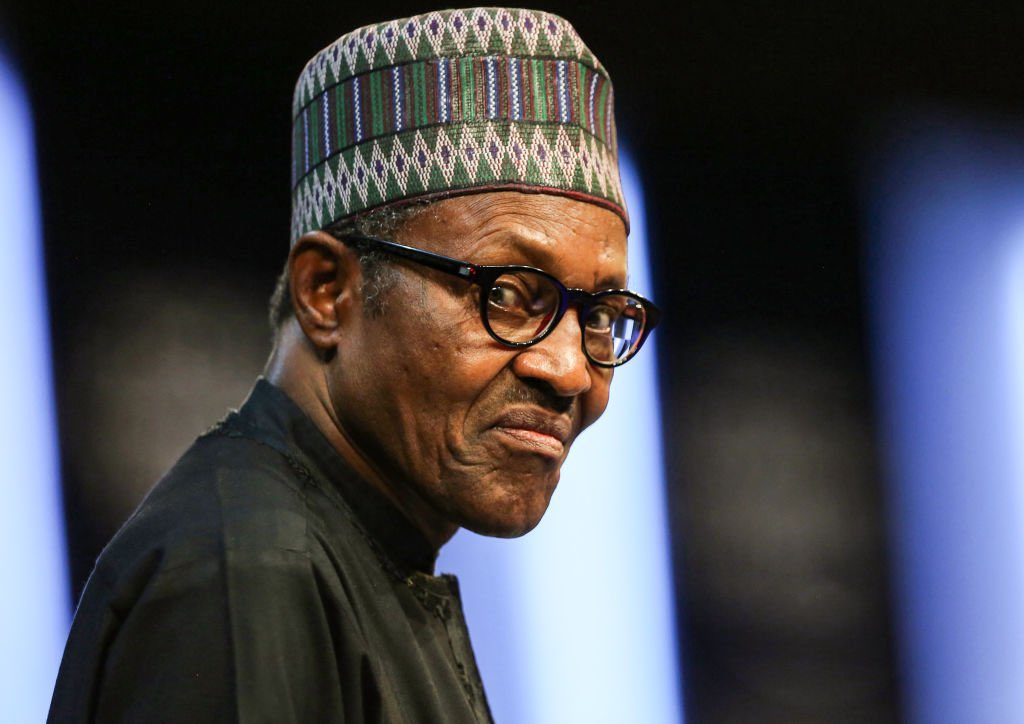
A renewed controversy has emerged over claims that Boko Haram, the extremist group that has plagued Nigeria for over a decade, once nominated former President Muhammadu Buhari to represent them in negotiations with the Federal Government.
This claim was recently reignited by former President Goodluck Jonathan during the public presentation of Scars, a memoir by former Chief of Defence Staff, Gen. Lucky Irabor (retd.), in Abuja on October 3, 2025. In his remarks, Jonathan stated that Boko Haram had, at one point during his administration, nominated Buhari as their preferred negotiator in a proposed peace dialogue with the government.
“One of the committees we set up then, the Boko Haram nominated Buhari to lead their team to negotiate with the government,” Jonathan said.
“So I was feeling that, oh, if they nominated Buhari to represent them and have a discussion with the government committee, then when Buhari took over, it could have been an easy way to negotiate with them and they would have handed over their guns. But it was still there till today.”
Jonathan said the continued existence of Boko Haram, despite Buhari’s presidency, suggested the conflict was far more complex than many perceived. He reiterated that his administration employed multiple strategies—both military and diplomatic—over five years, and expressed hope that current and future governments would adopt innovative approaches to resolve the crisis.
However, the claim that Boko Haram nominated Buhari as a negotiator has been strongly denied by Buhari’s allies, who argue that the narrative is not only false but also politically motivated.
In a detailed rebuttal, Garba Shehu, former presidential spokesman for Buhari, described Jonathan’s statement as “a false start” in what he suggested may be a campaign strategy ahead of the 2027 elections.
“Muhammad Yusuf or Abubakar Shekau, the deceased leaders of the Boko Haram terrorist group, never nominated Muhammadu Buhari for any such role,” Shehu stated.
“In fact, Shekau routinely denounced and threatened Buhari, and their ideologies were in direct opposition.”
He reminded the public that in 2014, Buhari narrowly escaped a Boko Haram assassination attempt in Kaduna, an attack that left some of his staff injured.
Further clarifying events from the past, Shehu referred to a 2012 press conference in Maiduguri, Borno State, where a man claiming to be a Boko Haram commander, Abu Mohammed Ibn Abdulaziz, named Buhari and several northern elders—including the late Senator Bukar Abba Ibrahim and Shettima Ali Monguno—as potential mediators. However, the group’s official leadership under Abubakar Shekau swiftly disowned Abdulaziz, asserting he had no mandate to speak on their behalf.
At the time, Buhari also publicly rejected the nomination, declaring he was unaware of it. Engr. Buba Galadima, then National Secretary of the Congress for Progressive Change (CPC), said:
“As at 10pm yesterday when I spoke with him, he said he has not even heard about it. He said the whole thing, to him, is just speculation.”
The party’s then publicity secretary, the late Mr. Rotimi Fashekun, alleged that the People’s Democratic Party (PDP)-led government was exploiting the story for political gain. He maintained that Buhari had never been associated—directly or indirectly—with any insurgency, describing him as a “quintessential patriot.”
Fashekun went further to suggest that the Boko Haram story had multiple layers, including a “Political Boko Haram”—a faction allegedly manipulated by elements within the government to create insecurity and extend their grip on power. He accused the PDP of being complicit in fostering insecurity to achieve political ends, citing statements made by President Jonathan himself and his former National Security Adviser, Gen. Andrew Azazi, who once admitted the infiltration of Boko Haram into government.
The debate underscores the deep political divisions and blame-shifting that have characterized Nigeria’s fight against Boko Haram. While Jonathan emphasized that Boko Haram’s survival despite successive governments’ efforts shows the complexity of the crisis, Buhari’s allies argue that past governments used his name in misinformation campaigns.
Jonathan also acknowledged that Boko Haram’s actions went beyond poverty or hunger, pointing to the group’s access to sophisticated weapons as evidence of external support. He called for a new, comprehensive approach involving both military force and dialogue, and suggested that someday, perhaps, former Boko Haram leaders might write their own accounts, providing much-needed clarity on their motives.
As the 2027 election season looms, the resurfacing of this issue has sparked renewed scrutiny of both Jonathan’s and Buhari’s legacies in handling Nigeria’s most enduring security threat.
