
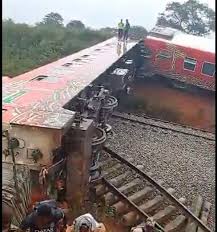
The Nigerian Safety Investigation Bureau (NSIB) has released its preliminary report on the Abuja-Kaduna train derailment that occurred at Asham Station on August 26. The report, made public on Wednesday, attributes the incident to a malfunctioning switch mechanism at the station.
According to the findings, the automatic crossing point switch mechanism at Asham Station was unserviceable at the time of the derailment. The switch had to be operated manually and was secured using a point clip—which was found to be broken.
NSIB emphasized that this equipment failure was the primary cause of the derailment, which involved train number AK1, operated by the Nigerian Railway Corporation (NRC). The train was carrying hundreds of passengers, NRC crew members, security personnel, and service staff.
The derailment caused the locomotive and all seven coaches to overturn. Although there were no fatalities, 21 passengers sustained varying degrees of injuries.
This incident marks the second derailment at Asham Station in just 13 months. The report noted that some of the railway sleepers damaged during the earlier occurrence had only been patched, rather than properly replaced.
In addition to infrastructure issues, NSIB highlighted several operational shortcomings:
• NRC personnel had only received initial training, with no formal refresher courses provided.
• Critical operational, maintenance, and safety equipment—including spare parts—were not readily accessible.
• Several instruments remained defective, including CCTV cameras and station clocks, all of which are vital for monitoring and operational efficiency.
NSIB Recommendations
To prevent future derailments and improve rail safety, the NSIB made several key recommendations:
• Track Repairs: NRC should replace all damaged or compromised sleepers to ensure track stability.
• Switch Mechanism Replacement: All point switches at Asham Station and along the Abuja-Kaduna corridor should be replaced with original equipment manufacturer (OEM) parts to ensure reliability.
• Cautionary Zones: NRC should reassess areas where caution advisories are issued to train drivers to enhance operational safety.
• Refresher Training: Formal refresher training should be provided for NRC staff to keep them current with safety procedures and best practices.
• Equipment Restoration: All defective systems—including CCTV cameras, clocks, and communication tools—should be restored to OEM standards for improved monitoring and operational efficiency.
NSIB stated that a final report will be released following further investigations. This will include:
• Detailed inspection of track alignment and infrastructure conditions.
• Technical examination of the locomotive, derailed coaches, brakes, wheels, and bogies.
• Analysis of crew statements from the driver, assistant driver, conductors, and guards.
• Review of train operation records, passenger and eyewitness accounts.
• Further analysis of the broken point clip.
The final report will provide comprehensive conclusions and additional recommendations to enhance rail safety in Nigeria.
