
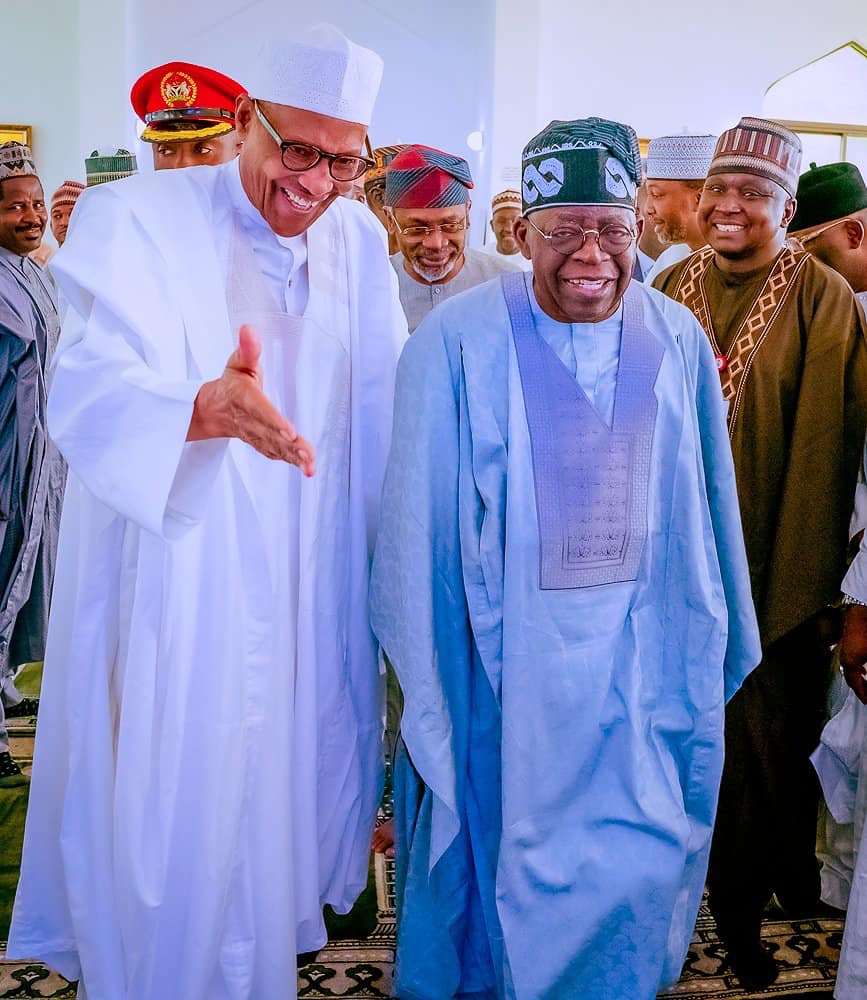
Temitope Ajayi, Senior Special Assistant to the President on Media and Publicity, has pushed back against former Secretary to the Government of the Federation (SGF), Boss Mustapha, over his recent claim that President Bola Ahmed Tinubu played no decisive role in Muhammadu Buhari’s emergence as President in 2015.
In a social media post, Ajayi asserted that while Buhari indeed had a strong base of “12 million captive Northern votes,” he failed to win the presidency in three successive elections—2003, 2007, and 2011—before the game-changing events of 2015. Ajayi argued that Buhari’s success that year was largely due to the strategic support and political machinery of then-APC national leader, Bola Tinubu.
Citing the pivotal All Progressives Congress (APC) primary held at Teslim Balogun Stadium in Lagos in 2014, Ajayi said Tinubu was instrumental in rallying APC governors and South West delegates behind Buhari. “There is no way Buhari could have become president without first winning the APC presidential ticket,” he wrote. “And he wouldn’t have won that primary without Tinubu’s backing.”
Ajayi accused Mustapha of distorting recent political history, calling his remarks at the book launch of According to the President: Lessons from a Presidential Spokesperson’s Experience—a memoir by Garba Shehu—“a disservice.” He emphasized that “every effort and support that made Buhari’s victory possible should never be diminished.”
Mustapha, speaking at the event, had downplayed Tinubu’s role, insisting that Buhari’s victory was rooted in his personal political capital. “When you sum up the total votes that gave us victory in 2015—15.4 million—Buhari already had 12.2 million. The other legacy parties, including Tinubu’s ACN, contributed only about 3.2 million votes,” Mustapha stated.
However, critics quickly dismissed Mustapha’s comments as both “ungracious and self-serving,” noting that Buhari’s previous attempts had all ended in failure until the formation of the APC coalition, spearheaded by Tinubu and other key figures. They added that in the 2015 general election, the People’s Democratic Party (PDP) polled 12,853,162 votes—more than Buhari’s pre-coalition base of 12.2 million—indicating that without the APC alliance, Buhari would have lost again.
Despite the political undercurrent, the event itself celebrated Garba Shehu’s memoir and drew a high-powered audience. President Tinubu, represented by current SGF Senator George Akume, commended Buhari’s contributions to nation-building and pledged to sustain and build upon his legacy. “Nation building is a relay,” Tinubu said. “The effort of one administration lays the foundation for the next.”
Former Head of State General Yakubu Gowon (retd) praised Buhari’s steady leadership, while Professor Ibrahim Gambari, former Chief of Staff to the President, used the platform to advocate for a more deliberate and thoughtful process in selecting Nigeria’s future leaders.
Former Vice President Yemi Osinbajo led a delegation of officials from the Buhari administration and described Garba Shehu as a loyal and consistent voice who shaped the administration’s messaging during turbulent periods. “This book is more than a memoir; it’s a historical record written from the trenches of governance,” Osinbajo said.
Femi Adesina, also a former presidential spokesperson, hailed Shehu’s calm under pressure and unwavering loyalty. Shehu himself said the memoir offers a candid, behind-the-scenes look at the inner workings of presidential communication and provides lessons for future government communicators.
